
Callanish (Calanais)
Isle of Lewis, Scotland
- pages by
Gerald Ponting
Isle of Lewis, Scotland
- pages by
Gerald Ponting






BRIEF DESCRIPTION OF CALLANISH :
Other stone circles have central stones or burial chambers within them, outlying stones just outside the circle or rows or avenues of stones leading away from them. The Standing Stones of Callanish, Tursachan Calanais in Gaelic, are unique in possessing all of these features; the stone rows are the most prominent part of the site.
Other stone circles have central stones or burial chambers within them, outlying stones just outside the circle or rows or avenues of stones leading away from them. The Standing Stones of Callanish, Tursachan Calanais in Gaelic, are unique in possessing all of these features; the stone rows are the most prominent part of the site.
The stones stand on a ridge above the waters of East Loch Roag, clearly visible from both east and west. The overall layout is shaped like a distorted Celtic cross, with five rows of stones radiating from the central circle. From north to south, the overall length is a little over 400 feet, from east to west it is about 150 feet.
At the centre is a small circle of thirteen stones, from eight to twelve feet high. The axes of the flattened circle are only 44 feet by 39 feet.
The tallest stone of all, at 15 9, stands near the centre of the circle.
The base of this central stone, and the bases of the two east-most circle stones, form part of the kerb of a tiny chambered cairn, 21 feet across.
Just outside the circle stand two stones, a tall one to the south-west and a short one, with evidence that it was once broken in half, to the south-east.
Two rows of stones form an avenue, which runs along the ridge, angled a few degrees east of north. It is 273 feet long and contains altogether 19 stones,
Five stones run due south from the circle towards a rocky outcrop, making a row 90 feet long. This is the row which initially inspired Professor Thom to commence his studies of circles throughout Britain.
The 76-foot long eastern row contains five stones, the western arm is shorter at about 42 feet, with four stones; neither row is accurately aligned on the compass bearing.
The tallest stone of all, at 15 9, stands near the centre of the circle.
The base of this central stone, and the bases of the two east-most circle stones, form part of the kerb of a tiny chambered cairn, 21 feet across.
Just outside the circle stand two stones, a tall one to the south-west and a short one, with evidence that it was once broken in half, to the south-east.
Two rows of stones form an avenue, which runs along the ridge, angled a few degrees east of north. It is 273 feet long and contains altogether 19 stones,
Five stones run due south from the circle towards a rocky outcrop, making a row 90 feet long. This is the row which initially inspired Professor Thom to commence his studies of circles throughout Britain.
The 76-foot long eastern row contains five stones, the western arm is shorter at about 42 feet, with four stones; neither row is accurately aligned on the compass bearing.

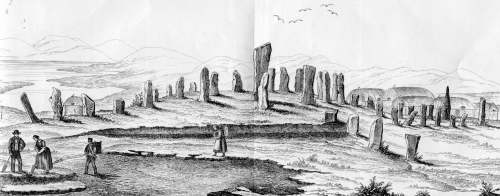
Engraving from a paper by Henry Callendar, 1854

Excerpt from ‘Going Round in Circles’ continues .....

BACK TO TOP

Click anywhere on the plan for a larger version
Web-site created by Gerald Ponting using Serif WebPlus X2
Latest revision of this page March 2009