What is the Electromagnetic Spectrum? |
Scientists
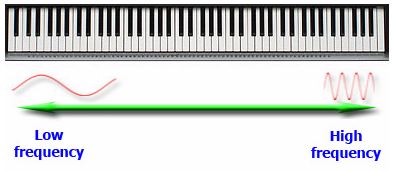
have found that many types of wave can be arranged together
like the notes on a piano keyboard, to form a scale.
The 'low
notes' have a low frequency and a long wavelength.
The 'high
notes' have a high frequency and a short wavelength.
When we
say "wave", you might think of a wave on the sea.
There, it's nice and obvious what's going on - the surface
of the sea is vibrating up and down.
With a sound wave, it's the air particles that are vibrating.
So what's
vibrating when an electromagnetic wave passes by?
That's not so easy.
Electromagnetic waves are vibrations of magnetic and electric
fields. So they
don't need air in order to travel. They don't need anything
to be there at all.
|
Caution:
don't get too hung up on this keyboard idea - sound waves are
NOT part of the electromagnetic spectrum |
What do I need to know about it? |
For your GCSEs, You'll need to know:
- The names of the types of wave
- The
order that
they're arranged in.
- The
uses of each
type of wave.
- How
each type of wave is made.
- The
dangers of
each type of wave.
- All
electromagnetic waves can cross
a vacuum.
- All
electromagnetic waves travel at the speed
of light.
|
|
Tips
-
The red words in this web site are the key ones.
- Where do the waves come from? You can almost always
get a mark for saying "stars"
- they give off the lot!
- Generally, the higher the frequency, the more the danger.
|
How do the waves fit into the electromagnetic spectrum? |
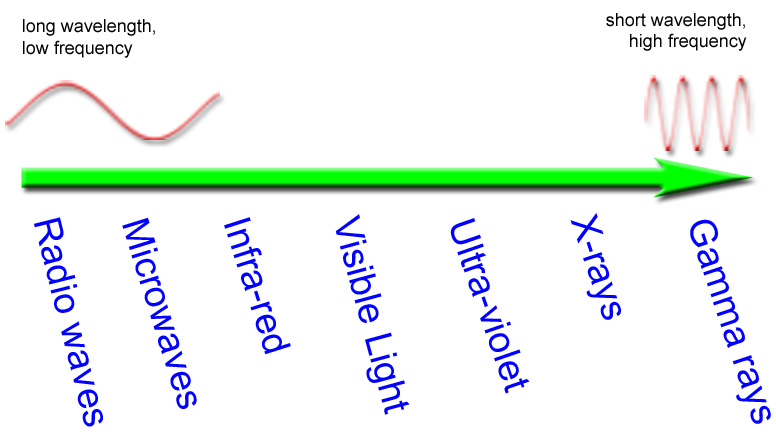
All
of these are "electromagnetic waves".
This means that although they appear to be very different, in fact
they're all made of the same kind of vibrations
- but at different
frequencies.
Use the buttons at the top of the page to find out about the waves
How do I remember all this? |
|
Try:
Rabbits
Mate
In
Very
Unusual
eXpensive
Gardens |
meaning:
Radio
Microwaves
Infra-Red
Visible light
Ultra-violet
X-rays
Gamma rays |
What do "wavelength" and "frequency" mean? |
Wavelength
means pretty much what it says - the length of one wave.
More precisely, it means the distance from the peak of
one wave to the peak on the next wave.
Strictly speaking, "the
distance from any point on a wave to the same point on the
next cycle of the wave". The peaks are just handy places
to measure from.
It may be measured in:
| kilometres |
km |
1,000 metres |
| metres |
m |
Awww, come on, you know how big a metre is! |
| centimetres |
cm> |
A hundredth of a metre. But you know this already. |
| millimetres |
mm |
1/1000th of a metre. Those tiny lines on your ruler! |
| nanometres |
nm |
1/1000,000,000th of a metre. Or, if you prefer, a millionth of a millimetre.
Small! |
Frequency is a word used in Maths to mean "how often something happens".
With waves, it's "how many waves per second"
It
may be measured in:
| Hertz |
Hz |
1 Hz means 1 wave per second |
| kilohertz |
kHz |
1 kHz is 1,000 waves per second |
| megahertz |
MHz |
1 MHz is 1 million waves per second.
Your favourite FM radio station probably broadcasts around 100 MHz |
| gigahertz |
GHz |
1 GHz is
1,000 million waves per second. Microwaves are around a few
GHz. |
|