|
|
|
|
 |
|
 |
Infra
red waves are just below visible red light in the electromagnetic
spectrum ("Infra" means "below").
You
probably think of Infr -red waves as heat, because they're
given off by hot objects,
and you can feel them as warmth on your skin.
Infra
Red waves are also given off by stars,
lamps, flames and anything else
that's warm - including you.
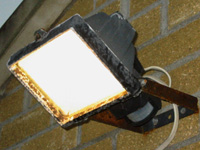
The
detector on this security light picks up the Infra red
radiation from your body. |
|
|
|
|
|
|
Infra-red
waves are called "IR" for
short.
They
are used for many tasks, for example, remote
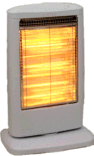
controls for TVs and video recorders, and physiotherapists
use heat lamps to help heal sports
injuries. IR is also used for short-range communications,
for example between mobile phones, or for the Dolby Screentalk
headset system used in some cinemas.
Because
every object gives off IR waves, we can use them to "see
in the dark". Night sights
for weapons sometimes use a sensitive IR detector.
Remember
the film, "Predator"?
|
 |
It
might surprise you to know that you probably have an
Infra red-sensitve camera in your pocket right now.!
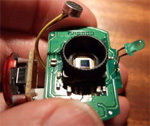
CCD
chips are used as pickup devices in digital cameras, including
camcorders and mobile phone cameras. |
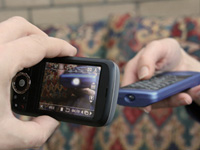
In fact,
the CCD chip has a filter on it to stop most of the infra
red from messing up the picture. But the photo shows that
enough gets through to tell if a TV remote control is working
or not. Try it - a handy diagnostic tool in your pocket!
This
YouTube clip shows it nicely:
|
|
 |
Want
to make an infra red camera using an old
webcam? There
are instructions at www.thenakedscientists.com
You'll
also learn something interesting about £5 notes... |
|

|
Apart
from remote controls, one of the most common modern uses for
IR is in the field of security. "Passive Infra-Red"
(PIR) detectors are used in burglar alarm
systems, and to control the security lighting that
many people have fitted outside their houses. These detect
the Infra-Red emitted by people and animals.
You've
probably seen TV programmes in which police
helicopters track criminals at night, using "thermal
imaging" cameras which can see in the
dark. These cameras use Infra-Red waves instead of "ordinary"
light, which is why people look bright in these pictures.
Similar cameras are also used by fire crews and other rescue
workers, to find people trapped in rubble.
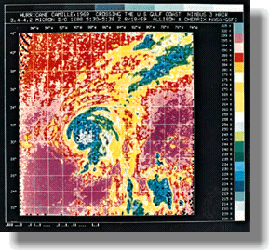
Weather
forecasters use satellite pictures to see what's
heading our way. Some of the images they use are taken using
IR cameras, because they show cloud and rain patterns more
clearly. |

|
The danger
to people from too much Infra-Red radiation is very simple
- overheating. |
|
|
|
|
|