|
Farthing Token ...
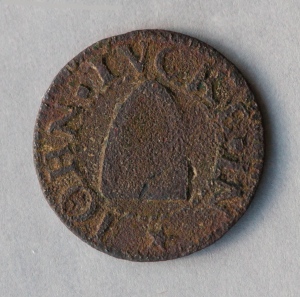
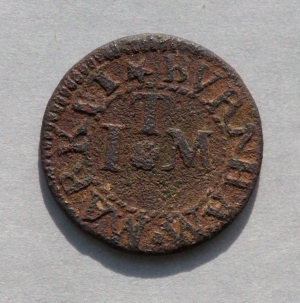
Probably 1660s. John Tucke was a grocer in Burnham Market, Norfolk, and used the Sugar Loaf as the sign of his shop. ***** Sugar Loaves .... ***** Plantations .... " I sold, last year, an 18th century mortgage [document] on several sugar plantations in Antigua. The sum involved was a staggering £10,000 and I hate to think what that would be in today's money." - a Monmouthshire Bookseller, 2001. ***** Whitechapel .... Alie St, Leman St, Mansell St, Prescott St - named after 4 sons-in-
law or grandsons of Goodman, the owner of the area [Goodman's Field, Goodman's Stile]. Deed .... 1815 ... between Daniel Austin & John Glennie, sugar refiners of Dock St, and Creditors. It would appear that Austin & Glennie were in "great debt", and needed to sell property. The
deed lists the messuages in Whitechapel and St Georges in the East, and gives names of tenants,
however, more importantly for us it also lists their creditors, many familiar names in the sugar
trade are included....... ***** Essex census returns .... The numbers returned as working in sugar refining in Essex, were ..... In 1881, there were 503 persons - 498 men & 5 women. ..... the vast majority in the refineries of Messrs Lyle and Tate. ***** Eggs .... From the 19 Feb 1690 Chancery proceedings regarding Whitson Ct Sugar House, Bristol; Webb v Pope & Whiting ..... "... Joan [Webb] had the money and was often consulted about the Sugar House, both in the
laying of pipes and the buying of eggs, 'without which the refining of sugar was impossible' ...
during the frosty weather of 1686 by sending out into the countryside messengers for them and
paying one penny a piece for the eggs." ***** Packaging .... 1803 ... Meeting of Bristol Sugar Refiners ... It was declared that a
resolution to make a charge on packages did not eminate from an individual house, but was the
general voice ... (13 in total). ***** Charles Dickens .... In 'On Duty with Inspector Field', Dickens describes accompanying
the inspector on a tour of public houses and hostelries to the east of the City, and says ...
"...I hardly know how such places could be better regulated. Not that I call the company very
select, or the dancing very graceful - even so graceful as that of the German Sugar Bakers,
whose assembly, by the Minories, we stopped to visit - but there is watchful maintenance of
order in every house, and swift expulsion where need is." ***** Costs .... In a listing of mid-eighteenth century London businesses, the start-up
costs of £1000-£5000 for a Sugarbaker were 5th out of 36, with only Merchant, Brewer, Mercer,
and Soap-boiler costing more. ***** Holland .... "In those same thirteen years [1615-28] the WIC [The Dutch West India
Company] captured a total of 547 Spanish and Portuguese vessels. Foremost among the booty, ... ,
were some forty thousand chests of Brazil sugar, valued at eight million guilders." .... "During
the 1630s the VOC [The United Dutch East India Company] shipped over one million pounds of
Chinese sugar from Taiwan to Europe." .... "The number of sugar refineries in Holland increased
during the 1650s by about half. By 1662 some fifty sugar refineries were operative at Amsterdam,
about half of the total for the whole of Europe. Another dozen or so were located at Rotterdam,
Middelberg, Delft, and Gouda. But in the 1660s the Dutch sugar boom broke. ... the number of
sugar refineries at Amsterdam slumped from fifty to thirty four." .... "By 1751 there were
around ninety sugar refineries at Amsterdam alone, another thirty at Rotterdam, and more at
Middelberg and Dordrecht." ***** Silvertown - Henry Tate & Sons .... In 1881 a photograph was taken of [some of ?] the refinery's workforce. Those in the photo are ... D. Blair, J. Stewart, J. Culville, T. May, T. Peacock, R. Lafferty, J. Shaw, G. Stark, W. Bass, W. Grainger, ? Flett, A.Reid, J. McCloy, O. Bringes, W. Scott, H. Nolte, R. McCarthy, T. Christy, J. Aitken, D. Mcall, W. D. Wall, ? McKenzie, H. Preece, ? Morris, W. McKissack, R. Mills, R. Downey, W. McNeill, M. McDonald, R. F. Wall, L. Johnston, A. McIlwraith, J. Allen, ? Nicholls, J. Lochead, A Harrison, D. Clacher, Geo. Tate, J. P. Muir, J. Blake, D. Girdwood, W. Hannah, ? Arnold, R Morgan. - with thanks to Ronald Crawford. ***** The Big Freeze .... In the worst winter of the 19thC, when much of London froze and
came to a halt - "the East London Water Company congratulated itself, in The Times
[28 Jan 1814], for having kept up the supply of water to the sugar refineries, but other
industries were presumably less fortunate, ...". ***** Insurance .... From 1775-87, the Sun Fire Office, and Royal Exchange Assurance,
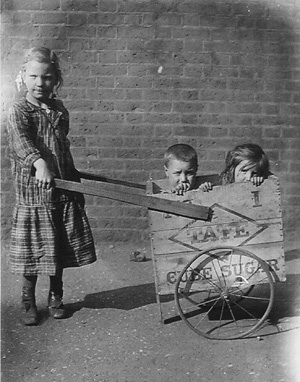
insured 131 sugar refineries. ***** The Rope .... Michael Schopman recalls being told that his grandfather always had a rope under the bed, in case of fire. For many years this meant nothing to him, but now the significance has become clear ... his grandfather was brought up amongst the sugar refineries in Whitechapel, and his great grandfather, a German, worked in one. ***** The Cart ... An alternative use for a Tate's box ...
... and yet another ... The Box .... From a pamphlet describing a small N Buckinghamshire town, early 20C ...
"The trotting of horses in those days was a far more pleasing sign than the present motor
car or motor cycle with its poisonous fumes. What a common sight it was to see a box of a well
known sugar firm, mounted on wheels, pushed along the streets with the necessary shovel to pick
up the manure and deposit same on the garden." ***** A New Refinery .... Today, 6 Jun 2002, I was offered the opportunity to bid for the
privilege of opening a new refinery. The e-mail read ..."To all Sugar Refiners.
A prospective sugar refinery project in southern Philippines is available. Estimated project
cost is US$300 Million. Please reply for more details. First come first served."
Utah's First Sugar Project .... In the 1840s, the leaders of The Church of Jesus Christ of Latter-day Saints decided to produce refined sugar from home-grown sugar beet. The process was researched, equipment purchased from Liverpool and dispatched to St Louis, and then taken by ox train the 1200mls to Salt Lake City. Delays and the loss of the most knowledgeable individuals contributed to the failure of the project, but years later they were to succeed. For more detail see the Vernon case study. ***** Privy Seal .... If you request document "Acc 850" at the London Metropolitan Archives, you will be presented with a small, 10"x8", blue cardboard attaché case. On opening, you will be surprised to see, not a document but, a large, heavy, wax tablet, 6" diameter x ¾" thick, engraved with a royal scene. On investigation you will find braided cords leaving the seal to the document safely folded beneath, with the script immediatly above the point of attachment reading "By Writ of the Privy Seal". The document itself is dated 8 April in the 8th Year of the Reign of George IV [1828], and appears to register an invention by Morton William Laurence, Sugar Refiner of Leman Street, London ... but what he invented, it does not say !! ***** Night Work - Male Young Persons, 1879 .... The Factory & Workshop Act of 1878
attempted to restrict the use of young labour. In their capacity as "... the only loaf
sugar manufacturers in the Country ...", Henry Tate & Sons, James Duncan, and David
Martineau & Sons, requested of the Secretary of State special exception from the Act, giving
a number of reasons. An Inspector recommended exception in that the lads were to be employed
in the process after boiling (where conditions are exceedingly hot) in the new moulding process
which has to be continuous. Conditions OK for lads. "Premises of Henry Tate are new, well
lighted, well ventilated, and temperate in atmospherical conditions, being entirely separate
from Boiling Dept". ***** The Smell .... "A gust of wind brings the thick spicy smell of molasses liquor
from Tate's. Jenny loves that overpowering Silvertown smell, the sheer weight
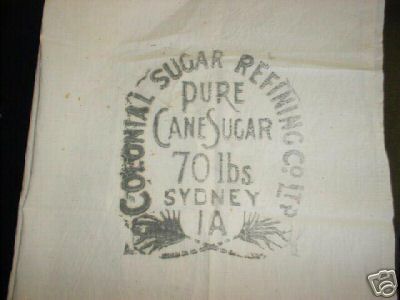
and history of sugar." ***** "A Sugarbaker's Outing" ... Nov 2002 ... the London List has just run a short thread ... ... and ... "A Sugarbaker's Treat" ... Sep 2012 ... from Jan Hill ... ***** London Today - Old Sugarbaker Names ... We are all well aware of the Tate Gallery on Millbank, and to a lesser extent Lyle Park in Silvertown, but there's also Goodhart Place at Horseferry, Martineau Estate off Cable Street, and I've just noticed Juxon Street in Lambeth. Any more for the list ??? ***** Letter of Application, c1870s ... A Sugar Refiner applying for a Situation. ***** Partnerships Dissolved ... Two announcements in the London Gazette refering to Bristol firms ... Bristol, May 28, 1803 Bristol, May 15, 1806 Sugar Bag ... Original calico sugar bag advertising - COLONIAL SUGAR REFINING CO. LTD. - PURE CANE SUGAR - 70lbs - SYDNEY - 1A. ...
***** English Sugar Duties, 1787 ...
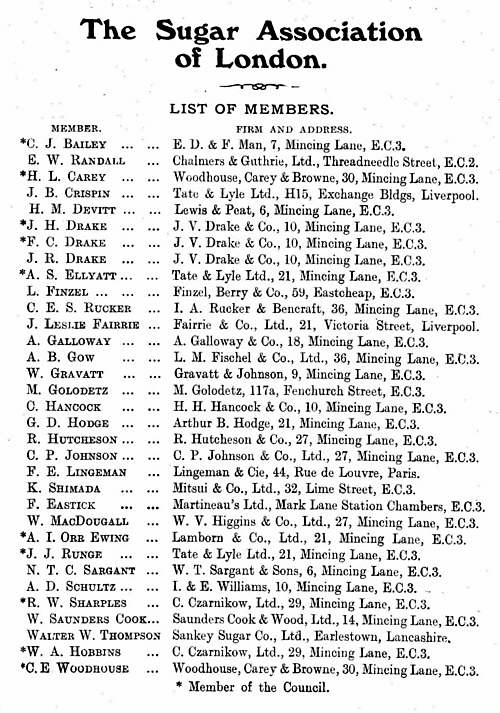
- from - Universal British Directory 1793-1798, Vol 1 Pt II London, Facs Ed, ISBN 1 898593 02 7. ***** Glasgow 1725 ... Special provision was made for the sugarhouse workers in Glasgow regarding their town guard fire duties ... "The magistrates represented that in pursuance of a former Act, daited the 11th December last, they had mett with the proprietors of the sugar houses and had received in from them some proposals, viz. that upon the toun's exeeming their servants from keeping of the toun guard, in respect their labour and work in the sugar houses nessessarilly requires their working in the night time ass well as throw the day, they in liew theirof agree and condescend that the sugar house boyler of each sugar house shall be ready at all times when fire happens in the city, on their being advertised by drum or bell or first alarm therof to attend the magistrates and give their best help and assistance, the toun providing each suggar house with foir slings and stands and buckits, so that on the first occasiounne of fire, shall come to the place with them filled with water and they will observe the orders and directions of the magistrates and others whom they sall apoynt; which being heard by the Council they agree thereto and remit to the Dean of Guild and Decon Conveinar to provide the said slings, stands and buckits." Extract from the Minutes of The Burgh of Glasgow, 11th December 1725, via; "Proud Record, The Story of the Glasgow Fire Service." Campbell Steven. 1975: Chapter II - Century of Progress, page 17, paragraph 3. (My thanks to Robert H James.) The Sugar Association of London, 1928 ... List of Members ...
***** Firemen in a Fix, 1908 ... "A Motor Car that saved the Situation - Daily Record and Mail, Monday, 10 August 1908 (My thanks to Robert H James.) ***** The Importance of the Sugar Trade to West Indies ... The opening page of the 1954 handbook of the British West Indies Sugar Association reads ... "The importance of sugar can be illustrated from the trade figures of our territories. For example, in Barbados the sugar industry accounts for 99% of the total exports; in British Guiana 50%; Jamaica 56%; St Kitts 89%. Why such dependence on one industry? The answer is fourfold - ***** Theft & Receiving ... "1751 April 1. Convicted also [at Kingston, Jamaica, assizes] John Kowff, sugar baker, for feloniously buying, knowing to be stolen 700 lb. of W. India cotton. --- This villain in less than 7 years, by practices of the sort, had raised from nothing above £2,500 and had carried on with impunity 2 sugar-baking houses, without scarcely buying one hogshead of sugar but such as had been stolen." Gentleman's Magazine. April 1751 issue, page 182. (My thanks to Steve van Dulken) ***** Full circle ... This whole website is about refining sugar ... at last it is slowly being realized that it is best not to !!! Organic Granulated Cane Sugar 500g packet - Whitworths Sugars, International House, 1 St Katherine's Way, London E1W 1XB. 2006. ***** Refining Monopoly granted - 1619 ... Patent to Mr Patrik Hamilton, Dominik Bowens merchant in London, and George Fentoun dwelling in the precinct of St Katherine's near London, and to their heirs and assignees, for the space of thirty one years after the date hereof, of the sole right of sugar refining within the kingdom of Scotland, with liberty to import all sorts of "basse sugaris" fit for refining, "as namelie Panceles, Stomas [S. Thomas], Muscavados, and the lyke," and to erect the necessary works, their imported and exported sugars to be free of custom duty for twenty one years to come, but in lieu thereof a yearly payment of £600 to be made by them to the royal exchequer. - Subscribed by the Chancellor, Mar, Wyntoun, Lotheane, Melros, Landirdaill, Privy Seal, Sir R Meluill, Sir G Murray. Extract from the 1619 Register of the Scottish Privy Council. (Volume 12, pages 91-2, in the British Library 1895 version) ***** Scurvy - 1767 ... A sugar-baker in Cheapside, was put into fresh earth up to the chin, in which situation he remained six hours, by way of remedy for an invertebrate scurvy, that had baffled the skill of eminent physicians. Gentleman's Magazine 10 May 1767 p277 - My thanks to Steve Van Dulken. ***** Hessian bags - 19th century ... ... most of the items were shipped in hessian sacks. Raw sugar was packed in 250lbs hessian bags. This was the largest size of bag that two dockers with hooks could work lifting all day. It seems an incredible weight today when the average size of sack is 100lbs [or 50 kilos]. No wonder dockers, especially in the West Indies, were broken men by the age of forty as the human frame wore out under such loads. Sugar & Spice - Edward Billington & Son Ltd, by John Billington, 1998. ***** Pay ... The personnel of a Bristol sugar refinery in 1878.
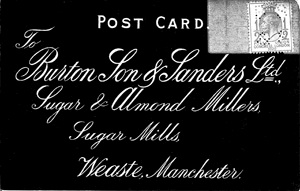
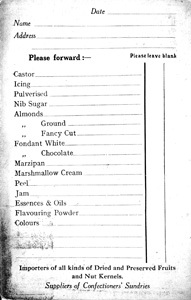
'The Making of a Sugar Giant, Tate & Lyle 1859-1989' by Philippe Chalmin, 1990. Postcard ... Original postcard produced for Burton & Sanders of Manchester, sugar millers. They were suppliers to the confectionery trade and this card appears to have been an early form of mail order ! ...
***** Paper ... 1666 February 16 ... British Patent number 147 ... Making blue paper used by sugar bakers and others. (AbeBooks, 2008) Personal Description ... was this the archetypal sugarbaker ??? ... Age 28 This was the written description, on 21 October 1854, in Gloucester, of Prisoner No. 571, Henry Meier, single, native of Hamburg, sugarbaker. He said he had previously worked at Edgar & Co [maybe Jager's]. He was charged, along with a seaman from Gloucester, with felony and committed for further examination 2 days later. (Gloucester RO - Gaol Q/Gc6/3) ... and was this the archetypal Georgian sugar refiner ??? ... Maria wrote, "My grandfather was a handsome and dignified old man, very kind to us, very courteous to everybody, wore powder and I think breeches and shoe buckles and was altogether very 'point de vise' in his accoutrements. We were very fond of him, admired and reverenced him, but did not confide in him. I think we were a little awe struck." 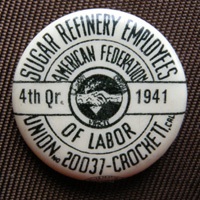
Union badge ... that I assume to have been an employee's indicator of union membership
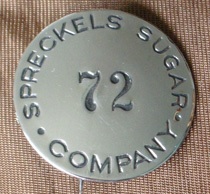
Employee badge ... for Spreckels Sugar Company, California; suggested 1920s - 1940s.
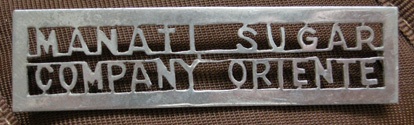
Company badge ... for the Manati Sugar Company, Oriente, Cuba;
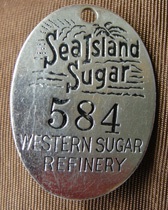
Employee badge ... for Sea Island Sugar, Western Sugar Refinery, San Francisco.
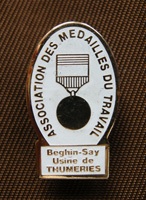
Company badge ... for Beghin-Say, Thumeries, Lille, France.

Company badge ... for Tbilisi Sugar Factory, Georgia.
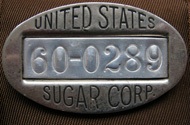
Employee badge ... for United States Sugar Corporation - worn by a guest worker / sugar cane cutter
Mrs Jane Clowes (1771-1827) - Confectioner of Manchester ... ... from Harland in his Collectanea Relating to Manchester (1866-67) ... ... from The Manchester Guardian of 16th June 1827 ... (My thanks to Keith Byrne) The Contrast ... "Inside the mill [in 21st century Mauritius], the air is deliciously steamy. Even the dust tastes sweet, as if it were snowing sugar." - from 'The sweetest flames', by Rose Prince. Telegraph Magazine 19 Nov 2011. ... Reading that immediately made me think back to 'At a Sugar Baking' - an extract from "The Wilds of London", by James Greenwood, in 1876, a time when London's refineries had been working for over 300 years ... "Just as unmeasured indulgence in sugar is nauseating to the palate, so was the reek of it palling to one's sense of smell. You could taste its clammy sweetness on the lips just as the salt of the sea may be so discovered while the ocean is yet a mile away." .... Zyklon B ... one of the FAQs on the website of the Berlin Sugar Museum ... "What does sugar have to do with Zyklon B? ...
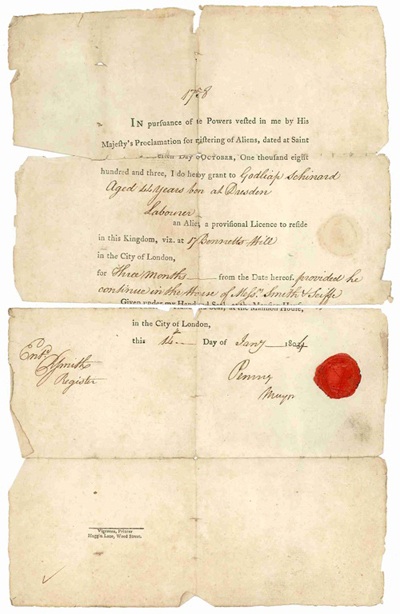
In the exhibition in the Sugar Museum, in the section on sugar refining, the by-products displayed include a can labelled "Giftgas Zyklon", or "Zyklon poison gas". The pesticide Zyklon B was used for mass murder in the gas chambers of the Nazi death camps. The misuse of the gas to murder millions in the Nazi concentration camps was a crime of unimaginable dimensions." Alien Certificate, 1804 ... Godliap Schinard of Messrs Smith & Seiffe ... On the 14th January 1804, this sugarbaker was granted 3 months residence, provided he stay (and work, I assume) at the sugarhouse of Smith & Seiffe at 17 Bennett's Hill, London. This certificate was with the papers of the Schoner family, the name coming from 'Schönherr', however was Mr Schinard, a 'Schinard', a 'Schönhardt' or a 'Schönherr', and how was he related to the Schoner family ?
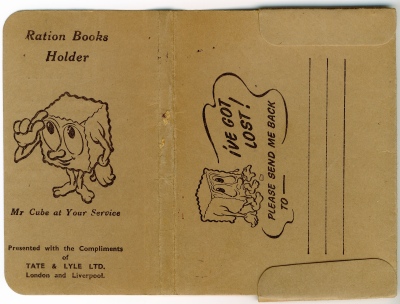
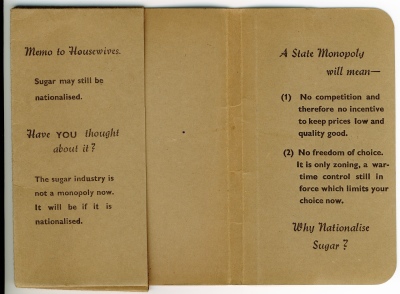
Bequest of a Sugar Loaf ... 1640 Aug 17 Will written by John Bigg, Jurat [Alderman] of Maidstone included a bequest of 20s "for a sugar loaf" to Mistress Mary Duke [his first wife's niece]. For comparison, John Bigg left Mr Thomas Swinnock his brother in law [a fellow Jurat], Mr Wilson and his wife, and Brother Wilding 40s each for a ring. ( My thanks to Judy Buckley. See Judy's Maidstone book; For the Good of This Town.) 'Jury' attacked ... Goodhart's, Horseferry Rd, Limehouse ... The Standard, 30 May 1834 ... The leet jury of Stepney arrived at Emanuel Goodhart's refinery in Horseferry Rd, Limehouse, with the purpose of checking the weights and scales therein. Having checked two scales, one deficient by 12 ounces and the other a false balance, a workman admitted they were inaccurate and also that the firm had been fined five years earlier for having bad scales. He then "called the men out" and the members of the jury were attacked by German sugarbakers who assembled from all parts of the building armed with staves and bludgeons. With some having been thrown down ladders and others beaten, the jury was forcibly removed from the premises. A magistrate granted warrants for the sugarbakers to be brought before the court. Ration Book Holder ... Tate & Lyle ...
Just one of the ways in which T&L got the message out regarding nationalisation of the industry. ( Thanks, Hilly.) Anthony Trollope ... from "Can You Forgive Her", pub. 1864 ... a father's advice to his daughter ... "Everybody should endeavour to stand as well as he can in the world, and if I had a choice of acquaintance between a sugar-baker and a peer, I should prefer the peer, - unless, indeed, the sugar-baker had something very strong on his side to offer. I donÕt call that tuft-hunting, and it does not necessitate toadying. ItÕs simply growing up, towards the light, as the trees do." (My thanks to Ian Rathjen, who adds ...) 'People in that mid-Victorian age must have been expected to know with some nicety just where a sugar-baker came in the social hierarchy!' More eggs ... Regarding Flamborough Head, E Yorkshire ..."In the months of May and June, the rocks seem absolutely animated, being covered with innumerable birds of various plumage, exceeding in number the inhabitants of the largest city, and in varied hue the tints of the rainbow. ... Hung in air as their nests seem to be, they are still not inaccessible to the depredations of man! Boys are let down the rocks by ropes fastened to stakes, and bring away bushels of eggs for the use of the sugar house in Hull, without seeming to diminish their countless number." (History, Directory & Gazetteer of Yorkshire, Vol- East & North Riding, 1823.) A man's best friend ! ... Early on Sunday morning some villians broke open a Sugarbaker's in Saffron Hill [London] and stole things to a large amount. When the family arose it was discovered that the thieves had left a small dog behind them, which was let loose, and followed by some of Sir John Fielding's men to the the Bull's Head, where the dog fondling on a very suspicious person, he was taken into custody, and, after a trivial examination, confessed himself to be a party in the robbery, and gave evidence against the gang, which consists of five desperate fellows, all of whom Sir John Fielding's men went in pursuit of. (Oxford Journal 21 Nov 1778.) Collapse ... Two houses collapsed in Snowhill, London ... they'd been hired for temporary storage of sugar by a sugarbaker of Thames Street. (Staffordshire Advertiser 1799.) Stolen from barge ... "A barge laden with sugar, the property of Mr Tunley, sugar refiner, Tower-street, which was lying at Union-stairs, was on the 28th inst. removed from her moorings and turned adrift near the Strand-bridge, after having been plundered of sugar of the value of £500." (Morning Post 1 Dec 1815.) Unusual theft ... "Twelve casks of bullocks' blood were stolen from outside the premises of a sugar refiner in Dock-street, Rosemary-lane, [London]." (Lancaster Gazette 1836.) Singular Revenge ... "Two workmen having quarrelled in a sugar-refiner's at Valenciennes, one of them threw his companion into a copper of thick molasses. The latter scrambled out, covered from head to foot with the sugary stuff, and angry at his adversary, rushed into the street, just as he was, to make his way to the King's Procureur to obtain legal redress. It was freezing very hard at the time, and the sugar became so firm that when he arrived at the house of the magistrate he looked like a substantial stick of barley sugar. His arms were glued to his sides, and he was compelled to ask a by-stander to ring the bell for him. This curious exhibition attracted crowds of spectators, and excited much merriment. - French paper." (West Kent Guardian 28 Jan 1837.) Highwaymen ... "A German Sugar Baker of Whitechapel was found in the road near Uxbridge, quite naked, and bound hand and foot. He had been robbed and stripped by highwaymen." (Exeter & Plymouth Gazette 11 Sep 1847.) Macfie - Charge Book of Greenock Refinery 1811-1848 ... Just a few snippets ... (An Old Minute Book - Edinburgh Sugarhouse Co 1763-1773 - by A C Cumming ... [Macfie info extra to ESC minutes]) Payment for Lease ... The lease, dated 20 September 1614, between Richard Perrin of St Mary Whitechapel and William Penton of London for a messuage in Grays Inn Lane, called the Blue Bell, for the terms of 70 years and 36 years (cellar) shows payment to be £30 p.a. and a 10lb sugar loaf. (Norfolk Record Office, Ref: NNAS G2/5/14) Sugar as payment for Church Rates ... The Norfolk Society of Friends took payments for Church Rates in various forms, including sugar ... Taken from ... (Norfolk Record Office, Ref given next to each entry) Golden sovereigns ... Having made his vast fortune, Henry Tate was asked by broker Arthur Hodge why he did not retire to the country and rest. ('56yrs in the London Sugar Market' by Gordon B Hodge, 1960) Hogsheads, hogsheads ... and the canal ... In 1830, the porter of Mr Jos. Coleman, grocer & cheesemonger of Bedford, went to Gt. Linford Wharf, Bucks, and collected 2 hogsheads of sugar and fifty four cheeses. The cheeses had been purchased at Leicester, but the documents do not say from where the sugar was purchased. This gave rise to two queries ... (The source of this article is the Bedfordshire Quarter Sessions. On the journey to Bedford all but 18 of the cheeses went missing near Astwood and two local men were eventually charged with theft. Char women ... During WWI women where required to fill the jobs of the men who had joined up. In a review of a recent Kate Adie book in the Observer, Sep 2013, a photograph was used of women in a Scottish refinery feeding the charcoal kilns. (The Observer, 22 September 2013) Utah, Salt Lake City, Sugar House Station ... 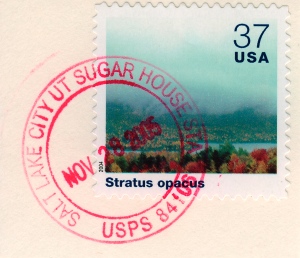
Postmark for the United States Postal Service Station at 1953 S1100E in the Sugar House district of Salt Lake City. To quote from Wikipedia ..."Sugar House is a neighborhood in Salt Lake City, Utah, United States. It is one of the city's oldest neighborhoods and the name is officially two words. Sugar House was established in 1853, six years after Brigham Young led the Latter-Day Saint settlers into the valley. Its name derives from the sugar beet test factory of the Deseret Manufacturing Company, which was established in a former blacksmith shop in the area with the assistance of Jersey-born convert Philip DeLaMare. The name came as a suggestion from Margaret McMeans Smoot, the wife of then mayor of Salt Lake City, Abraham O. Smoot." For more detail see the Vernon case study.
Whitechapel murders ... In September 1888, shortly after the murder of Polly Nichols, an eye witness stated ... 'Coming from school at the time above stated, I was just about to turn into Albert Street [Deal Street], by Cohen's Sugar Refinery, when a woman rushed across the street and screamed out, "There goes Leather Apron, the Whitechapel murderer", to the policeman standing at the corner of the turning." (Dundee Evening Telegraph, 6 Sep 1888) Correction ... The reference to Mr Cohen has always been a problem, with nothing more to confirm it. I have just received a newspaper cutting from Gary Barnett that clears up the confusion ... 
Company badge ... for Tate & Lyle, Thames Refinery, Silvertown.
Business card ... never any expectation of reaching 40,000 entries on the database, but there it is !
Before we refined our own ... "Talking of sugar, you will be amazed by the number of forms in which it comes. At the spice shop you will find an array of unrefined brown loaves weighing several pounds each and delicate cakes of refined sugar ('caffetin', 18d per lb in 1390), red and white flat sugars (cheaper, 12d per lb), Cyprus sugar (cheaper still, at 8d per lb), and then all the derivatives: pot sugar, sugar water, sugar syrup, rose sugar, violet sugar and barley sugar. The level of refining makes the difference between the cheapest sugars and the most expensive. Interestingly they are all used as spices (not as sweeteners) in sauces to accompany meat and fish dishes, especially those using vinegar, or in fruit pottages." ('The Time Traveller's Guide to Medieval England' by Ian Mortimer, Vintage, 2009.) London to Clevedon ... The partnership of Friend & Boden at 16/17 Fieldgate St, Whitechapel, dissolved in the 1830. William Boden continued the business to 1851 when he retired to Bristol and rented a house in Clevedon that had been converted from two salt workers cottages in the 1830s by a timber merchant. In 1859 the house was purchased by Bristol refiner Conrad Finzel jnr, and he moved into it himself soon after Boden's death in 1866. The house was called Salt House, and still stands, now run as the Salthouse Bar & Restaurant. William Boden took one of his German sugarbakers, John Frederick Ficken who had married and had a son in Whitechapel, with him as a valet. Ficken remained in Clevedon after Boden's death - he built himself a house, was parish clerk at St Andrew's for many years, and died around 1915 aged 80. Conrad Finzel sen leased a cottage in Old Church Lane in Clevedon in the 1840s and early 1850s, seemingly as a country retreat for his family, before he built the large mansion Frankfort Hall, now called Clevedon Hall. (My thanks to Jane Lilly for her local research.) Rumour ... "The Old Sugar House Company [Belfast] offered £52 10s regard to anybody giving information as to who started the rumour that a man fell into a pan of sugar and was boiled to death and that the sugar was afterwards sold." (Laws & Documents of Old Belfast) Consumption ... "As late as 1700 England consumed only 10,000 tons of sugar, though she had by that time 'sugar colonies' of her own. But by 1800 she consumed 150,000 tons. That is to say, allowing that the population had doubled, the average use of sugar by each Englishman had risen seven and a half times in the Eighteenth Century." (English Social History by G M Trevelyan, The Reprint Society, 1948.) The boiler's job ... "... From the evidence of the appellant it appears that he employed no male person whatever to write in any books in his counting house or warehouse, or keep any accounts in writing for him, except that the man called the boiler, who superintends the process of the manufacture of sugar, enters in a book an account of the quantities of raw material used, and the produce in marketable commodity, and that all books of account in the appellant's counting house are kept by himself only. From a case in Chancery in 1825 involving the refiner Henry Nibbs Brown, who successfully appealed against the commissioners opinion that the boiler was chargeable as a warehouseman. Java sugar ... "Greenock and the Java Sugar Trade - (Greenock Telegraph and Clyde Shipping Gazette 6 Sept 1889.) to Paraguay ... "The Settlers - (My thanks to Mary Godward for the link to her webpage.) Holydays ... Berenstein v Hodgson, Palace Court, 9 August 1839 "Sugar Bakers' Workmen, being yearly servants. Their legal right to certain holydays during the year -
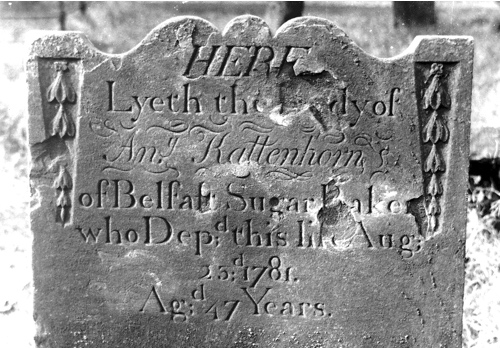
(Legal Guide Vol 1, 1838-9; Saturday, 17 August, 1839) Hexagon Moulds ... James Johnstone of Willow Park, Greenock, in 1847, was offering hexagonal sugar moulds. They added one quarter of the capacity to a standard circular mould, and because they interlocked, took up no more space on the filling floor. The moulds could be made of clay or sheet iron. He stated further advantages - less heat, less outlay, less insurance, less for annual repairs. (Greenock Advertiser 23 July 1847) Gravestone, 1781 ... Anthony Katterhorn died 23 August 1781, aged 47, and was buried in the Knockbreda Cemetery adjacent to the Parish Church, just outside Belfast. He was a sugarbaker working at one of the Belfast sugarhouses - one in Rosemary Lane, the other in Broad/Waring St. Whether or not this is the same Anthony Katterhorn, sugar boiler of Hull, whose son was baptised in Sculcoates in 1768 I've yet to prove.
Sundays ... "PRECEPT AND PRACTICE - The Bristol Gazette states that Mr W.C. Bernard, Honorary Secretary of the Bristol Committee for the Defence of the Lord's Day, is, or was up to a very recent period, partner in the large sugar house of Bernard, Vining, and Co., at whose establishment some half dozen hands are employed on Sundays, as on working days, at the furnaces, in order that the fires should be kept up to produce a uniform temperature." (Cheltenham Examiner 5 March 1856) Beat the Bounds ... "SIR - In or about the years 1847-8 I was one of the assembly who 'beat the bounds' of the parish of St. Augustine. Our way led us through the Sugar House, from Host Street to the Stone Bridge. As there was no door to the Sugar House in Host Street, we made an entrance by means of ladders through the windows of the first floor, and the boundary stone was found in the wall inside a closet, in the office near the front of the Stone Bridge entrance... (Bristol Times 16 November 1905) A Bristol Patent ... "Patent Sugar -- We understand that Messrs Harwood & Co will sell today the first make of sugar by a company who have erected machinery at the sugar house in Nelson Street, in this City, in order to carry out a patent granted to Mr Wright sometime since, for improvements in sugar refning. The sugar, which is said to be refined in a very short time from the worst refuse, is very bright, and it is expected will realise 61s per cwt. The profits are stated to be unusually great." (Bristol Mercury, 6 June 1846) ***** |
|
|
|