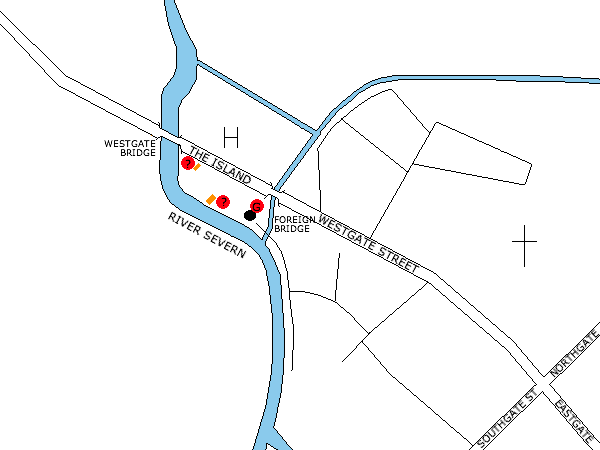
I think this was the early one implied in the document referring to the messuage occupied by the partners of the sugarhouse. (See below)

I think this was the early one implied in the document referring to the messuage occupied by the partners of the sugarhouse. (See below)
1722-29 PINFOLD John
1729> The group of Bristol refiners
1768> COOPER James & Joseph
1794?-1802 ERCKS Henry
I think this is the main sugarhouse described in 1710 as having 4 storeys and attics. (See below)
This is the location of the Glasshouse, round and purpose-built for glassmaking but at some stage probably used for sugar. (See below)
CLICK the  for sugar
houses in that street.
for sugar
houses in that street.
(For local directory of sugar houses, click here.) (For UK directory of sugar houses, click here.)
 |
|
The length of this map represents 0.6ml / 1km. |
**************************************
|
Sugar refining in Gloucester ... Gloucester gets no mention in 'Deerr' or 'Hutcheson' and maybe only served to process the excess Bristol imports that that city could not cope with, however it is surely worth mentioning here for there is evidence of small-scale refining for more than 100yrs.
1. Gloucestershire Victoria County History vol 4
The curious case of John Gardner's ledger ! ... John Gardner was running the Cheltenham Original Brewery in about 1800. He used a very large ledger in which to record what appear to be small brewery accounts. Just who was John Gardner? Was this not his first business? Was he previously a sugar broker or was that possibly the trade of his family? Just why did John Gardner use a secondhand ledger for his brewery business and use it in such a way that would suggest every spare square inch of unused page was of great value?? This ledger is held at the Gloucester Record Office under reference D5130/6/1 and tucked in between the marbled front leaves is a short hand-written note dated 24 Sep 1953 from Peter Mathias of Jesus College, Cambridge, which begins, "This ledger has been used for two separate purposes. The original entries [double page folios] 1771-1778 are those of a Sugar Merchant's business, including actual sugar buying, selling, brokerage, interest charges etc; and an occasional cotton transaction. Superimposed on this, in double columns per page are the personal accounts of (doubtless) John Gardner's Brewery 1800-1807. These include many small trade accounts, bricklaying and so forth, and probably contain all private sales of beer for the years in question, though no sales to public houses. ... The question still remains over when Gardner was in the sugar business as well as brewer and banker, or his father before him." Some of the names that head the double pages of the sugar entries read ... George Brucker, Turquand, John Walker, Goodhart & Wittich, Charles Cammeyer, Arney & Walker, Steilen & Doorman, George Deichman, Harman Samler, Helmken & Ratcliffe, Robert Walker, and Thornton & Watson. Not all the names, by far, but enough to show quite some portfolio of London's top refiners of the time as well as Thornton & Watson of Hull, not only dealing in sugar but also borrowing money. So why is this ledger so peculiar? .... take the Thornton & Watson pages - beautifully headed Thornton & Watson; three columns to the left of the page used for month, day, item sold; four columns to the right used for a number, £, s, d; with the central columns blank and using just over half the length of the page. However, this is now added to in a less tidy hand ... down those central columns are the accounts for 1806-7 of Mr Cotter at Barretts; and at the bottom of the page the accounts of Dr Cother 1806-7, Mr Neal at Llewellins 1802, Mr Chambers 1807 and Mr Rawlins the milkman 1812. The opposite page has added the accounts of Mr Eliker at Haywards 1806 and those of Mr Ingram the shoemaker 1801-3. Both pages are completely filled. These tables summarize the sugar-related entries ...
The ledger begins with two pages of Profit & Loss accounts for 1771 and 1772, but these appear, by my limited knowledge, to require other ledgers and journals from the brokers business for us to be able to understand how and where he was making his money. However ... Page 85 of the ledger shows the trading of sugar between the merchants and the refiners, via the broker, for the five months Oct 1773 to Feb 1774. Sugar originated from Jamaica, Grenada, St Kitts, and Montserrat, and was sold to the broker by 16 different merchants, but purchased by only 4 refiners, Chesmer & Ellertt (18 purchases), Margaret Lear (3), Wm Butt (1) and Helmkin & Ratcliffe (1). The profit margins, in the region of 2%-6%, vary from deal to deal, but I can find no common mark-up for individual sellers, buyers, or for the origin of the sugar. During those 5 months, the broker traded 470 hogsheads of sugar for a total of £10423, making a profit of £455. There appears to have been little activity, in sugar anyway, after 1774 ... only Samler's dealings are recorded. Was this because his business had folded or simply that he had concentrated on another commodity ? ... I'm sure John Gardner was not a sugar broker, so who was? ... ... after further research, here is one possibility ... The ledger was clearly that of a London sugar broker. The period 1770-1778 was too early for the ledger to be attributed to John Gardner (d.1836) himself, however we do know that he was a banker and common brewer (1), was a sleeping partner in the County of Gloucester Bank in 1812 (2), and a partner in the firm of Pitt, Gardner & Co bankers in Cheltenham in 1830 (3). The common connection here is 'banker'. William Fendall (will proved 1813) was a barrister and banker in Gloucester, being a partner in the Old Bank (4) and an investor in the Bullo Pill Railway (5). His will shows that he and his siblings, John, Mary & Harriett, were recipients of annual payments from the High Court of Chancery under the terms of the case of 'Fendall v. Nash', which dealt with legacies left to minors by the will of a bankrupt (6). Separately named in the will are William's married sisters Mary Newton and Harriett Moultrie who both married at St Marylebone, London, in 1788 and 1799 respectively. There's an indication that Harriett was born at Matson, Gloucestershire, about 1769 (7) ... and Matson is where William was living when he wrote his will. John Fendall, referred to as 'Dr' in The Times (10) and listed as a surgeon in the 1763 (11), appears to have had money to invest in 1777. With the trading of commodities doing well, he chose to invest large sums of money in a partnership with James Lodge, a merchant, packer, dealer and chapman of Little St Helens in the City of London (12)(13). However, Fendall "... who knew nothing about the business ..." (10) made a grave error of judgement, for without Fendall's knowledge Lodge immediately paid off a number of personal debts using these new funds from the business - possibly £36,000 (14). In March 1778, bankruptcy proceedings began against Lodge & Fendall (12). "Lodge v Fendall, 1 Ves. Jr. 166" shows that Fendall considered himself a creditor of the business with Lodge's use of company money an act of fraud, but Lord Thurlow found otherwise - "that those who, being in partnership, are themselves, or some of them, debtors to the creditors of every class, cannot come in competition with the creditors" (15). Correspondence (16) between Fendall's friends William Burford in London and Edward Rogers in Gloucester reflect their concern ... James Lodge was born in Little St Helens in 1738 son of John & Catherine Lodge who had married in Westminster Abbey in 1730. He appears to have married in mid-1760s and had eight children with wife Mary (7). The family firm had traded from Little St Helens since as early as 1735 (17) and Kent's Directories show them at 12 Little St Helens - 1759, Lodge John & Comp, Packers; 1769, Lodge John, James & John, Packers; 1771, Lodge, John, James and John, Packers; and in 1777 as Lodge & Fendall. Just like the Tielhen trade books that have survived from 20 or so years earlier (17), this ledger may have survived because it was saved as evidence for the High Court hearings rather than simply being disposed of at the close of Lodge's business. If so, it probably remained with the Fendall banking family in Gloucester and John Gardner eventually took it to use for his minor brewery accounts. * My first (short) study of the ledger led to this research ... the bankruptcy of Lodge & Fendall appeared to coincide with the last entries in John Gardner's ledger and I was sure that the ledger represented the sugar-trading activity of James Lodge 1771-1778, however, after a second (thorough) study of the ledger I am now far less certain. There is just one set of initials JL in the ledger and the London/Gloucester connections are all sound, but I'm now wondering about Samler's loan ... would such a respected businessman actually lend £4000 to a person who was undergoing bankruptcy proceedings, and if so why would Lodge record it in this ledger?? * 1 His will TNA Prob 11/1864 **
|
|
|
|