"15 Sept 1879, Hans Rathgen, age 69, sugarbaker. Cause of death - shock to the system from scalds through having fallen into a pan of boiling sugar. Accidental. Middlesex Coroner's inquest held 18 Sept 1879" This was the reality of the sugar refining industry ... hot, exhausting and dangerous.
Workers were expendable and continually exposed to the risks from boiling sugar, scorching
containers, scalding steam, heavy objects, poor building design, and, of course, fire. Below are lists of fatalities, which will be added to as new evidence is found. Contributions gratefully received. |
|
ARCHER, Henry ... aged 50, an engineer at Mr Williams of Betts St. He and a fellow worker were repairing a pipe in a 100ft deep well on the premises. He was returning to the mouth of the well when the rope-sling he was sitting in, attached to the crane, snapped about 20 feet from the top. Although admitted to hospital, he died the same day. Accidental death. (London Standard 1840) BARCLAY, James ... son of Daniel Barclay, drowned at Neill, Dempster & Neill's Refinery, Greenock, 17 Nov 1889, aged 5yrs 2mths. (Watt Library BMD Index online) BARRATT, John ... aged 52, labourer, scalded to death in boiler accident at Craven & Lucas, Duncan St, Whitechapel, 20 July 1843. Accidental death. (The Era) BECK, John ... "Struck on leg by cask of sugar ..." Accidental death, 20 Sep 1820, at West India Dock, Whitechapel. (Coroner's Inquest. LMA MJ/SPC/E/1088) BELL, John ... "Hogshead of sugar fell on arm." Accidental death, 1827, Whitechapel. (Coroner's Inquest. LMA MJ/SP/C/E/3245) BELL, Robert ... killed at the Roxburgh St Refinery, Greenock on 29 Jan 1906. (Watt Library BMD Index online) BERNHOLZ, Lowhe ... "Fell into a pan of boiling sugar." Accidental death, 1824, Whitechapel. (Coroner's Inquest. LMA MJ/SP/C/E/2158) BINFIELD ... foreman of syrup shed at Lyle's Plaistow Wharf, committed suicide at home, prior to 1906. (Plaistow Story, Oliver Lyle) BLACK, John ... aged 42, a charcoal man at Hall & Boyd, died at the London Hospital from severe scalds following the boiler explosion of Monday 12 Nov 1855. Verdict - accidental death. (The Times 16 Nov 1855) BLACK, John ... fireman, died on 13 Aug 1882 as the result of an accident at Ingleston Refinery, Greenock. (Watt Library BMD Index online)
BLIGH, William ... worker at sugarhouse of Mr Constadt in Well St at time of huge boiler explosion (see SPEAR, this page). Killed, 15 Nov 1815, leaving wife and two children. (London Courier & Evening Gazette, 17 Nov 1815) BOHLMANN, Harmann ... a 52 yr old German sugar boiler committed suicide by hanging, after returning from the West Indies where he had been for eight months out of the year. (The Times 27 Nov 1887) BOLTE, Jacob ... aged 29, killed in boiler explosion at Schurrier & Benson, London, 26 Jun 1863. (Lloyd's Weekly Newspaper) BONNAR, Henry ... "aged 3 years, son of a labourer residing in Highland Close, was "scobbing" sugar from hogsheads which were being transported on a car along Shaw Street, the little fellow stumbled and fell in front of the wheel, which passed over him, death being instantaneous", Greenock, 23 Jun 1880. (Dundee Evening Telegraph / Glasgow Herald) (Rootschat) BORN, Frederick William ... aged 49, died as the result of a violent brain concussion after falling from a stair landing onto a roof at Martineau's refinery in Christian St, London, 16 Mar 1890. (Death cert & inquest - Phil Jones - family research) BOSCHEN, Nicholas ... night watchman, aged 60, at Macfie's in Batchelor St, Liverpool, died suddenly whilst on duty. Inquest verdict - natural causes. May 1859. (Liverpool Mercury) BOSTOCK, William ... Large explosion at the Garston Sugar Refinery, Liverpool, on 30 Oct 1894, when 3 men were killed. William Bostock, the owner, died the following February. He had joined in a search for a missing man on the morning after the accident and helped dig through the rubble. When the body was found it was in a dreadful state. A traumatic experience for him no doubt. (Local Press) BOVEL, James ... a mason, died in Dec 1881, as the result of an accident at the Glebe Refinery, Greenock. (Watt Library BMD Index online) BOYD, James ... a sawyer, aged 33, died a day later from injuries he received in the Orchard Refinery, Greenock, on 25 Oct 1881. (Watt Library BMD Index online) BOYD, John ... labourer, aged 56, died at Greenock Infirmary on 7 Mar 1894 the day after an accident at Brewer's Sugar Co, Greenock. (Watt Library BMD Index online) BRANNIGAN, William ... a labourer, died on 23 May 1885 following an accident at Roxburgh St Refinery, Greenock. (Watt Library BMD Index online) BROGAN, Daniel ... a coppersmith, died on 12 Dec 1903 after an accident at Neill, Dempster & Neill's Refinery, Greenock. (Watt Library BMD Index online) BROGAN, Thomas ... labourer, after an accident at Walker's Refinery, Greenock, died the following day, 29 Oct 1892, at Greenock Infirmary. (Watt Library BMD Index online) BROOMFIELD, Henry Hal ... "... aged 42, of 55 Strathblaine Rd [Battersea]. While deceased, a charge hand at Messrs Gartons, Southampton Wharf, was assisting to clean out a sugar tank early on Saturday morning [17 Sep], the electric light failed. In lighting some gas jets he fell into the tank, which had a few inches of hot liquid in it. Though badly scalded he was able to climb out and call for help. His companions rushed to him and he was quickly taken to St James's Infirmary. He died there on Monday [19 Sep]. The jury returned a verdict of 'Accidental Death' " (South Western Star 23 Sep 1927) BRYANT, George ... "Cask of sugar rolled on his leg ... at Poplar ... on 15 May ..." Accidental death, 21 May 1821, Whitechapel. (Coroner's Inquest. LMA MJ/SPC/E/1263) BUPENIUS, James ... "Being in the hold of a ship in the London Docks, he was hit by a falling hogshead of sugar." Accidental death, 1831, St George. (Coroner's Inquest. LMA MJ/SP/C/E/4819) CALDER, John Wilson ... son of an iron moulder was knocked down by a sugar lorry and died in Greenock Infirmary 10 May 1887. (Watt Library BMD Index online) CAMPBELL, Lachlan ... killed in an accident at the sugar store, Albert Harbour, Greenock on 7 Aug 1876 aged 40. (Watt Library BMD Index online) CARMICHAEL, Henry ... labourer, died in an accident at Roxburgh St Refinery, Greenock on 5 Mar 1887 aged 20. (Watt Library BMD Index online) CLAPPERTON, Thomas ... killed in an accident at John Walker & Co, Greenock 14 Oct 1875. (Watt Library BMD Index online) CLINE, John ... "... in the employ of John Sickling for about 6 months; whilst unloading a wagon fell with the pulley and a cask rolled over him." Broken ribs and serious injury to thigh - died in hospital. Accidental death. (The Morning Chronicle 16 Jan 1817) COCKLIND, Jeremiah ... "Box of sugar fell on leg." Accidental death, 1826, Whitechapel. (Coroner's Inquest. LMA MJ/SP/C/E/2814) CONNOR, John ... "That on the eleventh day of December [1819] ... the said John Connor being at work in a certain sugarhouse [in this parish] it so happened accidentally casually and by misfortune that one of the ceilings of the said sugarhouse gave way and fell upon him ... he did receive mortal bruises and fractures on the head and body ... he did languish and live in the parish from [that day] until the eighteenth of January [1820] ... when he did die ... the jurors do say that he accidentally came to his death and not otherwise." Inquest, 20 Jan 1820, Whitechapel. [By a huge coincidence, the Foreman of the Jurors for this Inquest was my 3xgt grandfather Henry Almeroth, age 25, grocer of that parish !] (Coroner's Inquest. LMA MJ/SPC/E/0878) COONAN ... "The plaintiff's son, a boy of 15 years, obtained employment in their establishment, and his business was to assist in washing large sugar casks. This process was carried out in a large tank filled with water heated above boiling point. Those engaged in washing stood upon a platform which sloped towards the tank. From the constant overflow of the water the platform became slippery, and it was alleged that, owing to insufficient protection, the lad tumbled in and was scalded to death." A case brought before the Queen's Bench in Dublin against Bewley's, sugar refiners of Great Brunswick Street, to recover damages for the death of the plaintiff's son. (The Irish Times 14 May 1874) COOTER, Charles ... "... of Germany. Working on repairs in Goodhart's sugarhouse on 10 Oct when fire broke out ... burned to death ... unlikely his body would be recovered" (Morning Chronicle 12 Oct 1860) [see below] COPE, John ... "Pot fell on head while working in sugarhouse ... died instantly ..." Accidental death, 14 Aug 1822, Whitechapel. (Coroner's Inquest. LMA MJ/SPC/E/1647) CORDES, Frederick ... crushed in steam lift at Messrs Schwartz, Whitechapel, on 17 Aug 1874. (Daily News) CORDES, Johann Diederick ... "... in the service of Hall & Boyd, Breezers Hill, London ... on Sat 30 March proceeded with a lighted candle to clean out a tank filled with charcoal. The morning was dark, and on removing the lid he placed his legs inside the tank, when the foul air ignited, and blew him backwards about ten feet against a wall. The deceased was found by Hermann Henckin and John Buck in a dreadfully disfigured state, being burnt over the arms, face and body to a considerable extent. He was taken home, and subsequently was conveyed in a cab to the London Hospital, where he lingered and died on Sunday evening last [14th]." Inquest - Accidental death. (The Daily News 18 Aug 1853) CURRAN, Peter ... a labourer, died in the Infirmary following an accident at Blair Reid & Steele's Refinery, Greenock on 30 Sep 1861. (Watt Library BMD Index online) DAVIDSON, Thomas ... labourer, killed in the Cartsburn Refinery, Greenock, on 30 Oct 1879 aged 27. (Watt Library BMD Index online) DAVIS, Mary ... "Hogshead of sugar fell on leg." Accidental death, 1828, Whitechapel. (Coroner's Inquest. LMA MJ/SP/C/E/3620) DEVINE, Daniel ... a labourer, died in Greenock Infirmary on 10 Jun 1901 after an accident at Brewer's Sugar Co on 8 Jun 1801. (Watt Library BMD Index online) DICK, David ... labourer, killed in Walker & Co's Refinery on 21 Jan 1896 aged 63. (Watt Library BMD Index online) DONOVAN, Dennis ... bricklayer's labourer fell from a ladder at William Pell's sugarhouse on 4 May 1785. (London Lives / LMA (Middlesex Coroners)) DUFFY, Patrick ... employed at Anderson, Orr & Co, died when caught in machinery there on 26 Jul 1855 aged 20. (Watt Library BMD Index online) DUHN, George ... a 61 yr old labourer at Martineau's in Christian St, discovered lying in a tank of boiling syrup. Verdict - accidental death. (The Times 26 Nov 1891) DUNLOP, Robert ... a warehouseman, killed at Blair Reid & Steele, Greenock on 29 May 1865. (Watt Library BMD Index online) DUNLOP, Robert ... labourer, who disappeared on 2 Jan 1877 ... body found in Victoria Harbour 18 Feb 1877. (Watt Library BMD Index online) ECKWORTH, Henry ... "Case of sugar fell on him from a truck ..." Accidental death, 10 Oct 1820, at London Docks, Whitechapel. (Coroner's Inquest. LMA MJ/SPC/E/1100) EDWARDS ... "A cooper, burned to death in the fire at Mr Daubeny's sugar house [Bristol]." Before 1808. (B+G Arch Soc - Transactions, vol.85) EDWARDS, John ... died in an accident at the Roxburgh Street sugar works, Greenock, on 9th October 1851. (Watt Library BMD Index online) FEARING, Hanry ... "Fell from top of sugarhouse." Accidental death, 1825, Whitechapel. (Coroner's Inquest. LMA MJ/SP/C/E/2606) FEDDEN, [Ehlert] ... died whilst working for Davis & Finzell, Counterslip, Bristol, 1841. "... he was engaged, with other men, in pulling up lump sugar in boxes, from the ground floor to the fourth floor. The deceased had himself fastened the chain to a box, but in consequence of its being insecurely fastened, it gave way at the third story, and the box, with four lumps of sugar in it, fell over through the trap door and struck the deceased on the back part of his head, fracturing the skull, from which a large portion of the brain protruded. The deceased was immediately taken to the Infirmary, but nothing could be done for him, and he expired in a few minutes after his arrival there. The deceased was a married man, and has left several children. Verdict, Accidental death, with a deodand of 1s." (Bristol Mercury 6 Mar 1841) FEDDEN, John Carsten ... killed at work at Finzel's, Bristol, in 1872, having become entangled in moving machinery. (Letter from Contributor 1) FERGUSON, James ... labourer, died at Greenock Infirmary, on 3rd August 1910, after an accident at Glebe Sugar Refinery, 13 West Blackhall St. (Watt Library BMD Index online) FILLING, Christopher ... "Fell through pulley hole in sugarhouse ..." Accidental death, 6 April 1821, Shadwell. (Coroner's Inquest. LMA MJ/SPC/E/1226) FRAZU ... employed by Mr Wackerbarth, Limehouse ... was placing loaves in the stove, 10ft square and heated to 100 degrees, when he fainted. Was taken to hospital where he died two hours later. Verdict of inquest - Apoplexy, by having been exposed to excessive heat. (The Examiner 1840) FREDERICHS, Heinrich ... a worker at Hall & Boyd, died at the London Hospital from severe scalds following the boiler explosion of Monday 12 Nov 1855. Verdict - accidental death. (The Times 16 Nov 1855) GALLACHER, Daniel ... aged 36, killied at Tate & Lyle, London; buried at Old Monklands Cemetery, Scotland, 1948. (Old Monklands Cemetery Records) GAMBLE, William ... at Lyle & Son's Wharf, Silvertown. His death was caused by 'the overbalancing of a crane' that he was working on. 12 Feb 1892. (Lynne Bean - family research) GARWOOD, George ... "A vat of sugar fell on his leg." Accidental death, 1834, Whitechapel. (Coroner's Inquest. LMA MJ/SP/C/E/5719) GAVIN, John ... aged 55, of Haddo, Scotland, a highly respected engineer in Natal, South Africa, whilst inspecting sugarhouse machinery slipped and fell into a large cauldron of boiling sugar. He survived just 24 hrs, and died 19 October 1875, leaving a widow and one child. (Montrose, Arbroath and Brechin Review, 10 Dec 1875) GEVERS, Christoff ... aged 48 residing in Cable St, "a top plate of one of the cylinders flew off, and striking against another machine, rebounded and struck deceased on the legs, cutting one off and fracturing the other." Killed at work at Martineau's, Christian St, on 3 April 1878. (Lloyd's Weekly Newspaper) GLOVE, Frederick ... a German in the employ of Slack & Burgess sugar refiners of Gravel Lane, Houndsditch, died 1807 as a consequence of taking prescription medicine made for him by a chemist. (Gentleman's Magazine) GORMAN, Joseph ... 30 Dalrymple Street, killed at Mr MacEachran's sugar refinery, Sugarhouse Lane, Greenock on 10th December 1880. (Watt Library BMD Index online) GORMLEY, Patrick ... age 48, of Boxley St, Silvertown, died from his injuries following a boiler explosion at 1.15am at Tate & Lyle, Silvertown, 28 Dec 1995.(Aberdeen Press and Journal; Reading Evening Post) GOULDING, George ... age 31, a worker at Finzel's, Bristol, died in cistern explosion, 1865. He left a wife and 2 children. Verdict - "the material with which the cistern had been made was too thin." (BRO 36772 Box 6) GRAHAM, Angus ... carpenter, 7 East Shaw Street, died when he fell into a tank of boiling water at Roxburgh Street Sugar Refinery, Greenock, on 19th May 1886 age 70. (Watt Library BMD Index online) GRAHAM, John ... sugar porter's labourer, 19 Hamilton Street, Greenock, drowned near Caird's Shipyard on 3rd August 1872. (Watt Library BMD Index online) GRAHAM, Lawrence ... labourer, 28 Westburn Street, died in Greenock Infirmary on 29th August 1877 from injuries received in an accident at Walker's sugar refinery age 45. (Watt Library BMD Index online) GRAMLICH, Jacob ... died in an accident at work in a Sugar House at 15 Christian St, St George in East on 27 Nov 1877. Following an inquest, his death certificate read ... "Labourer at a sugar refinery - violent - contused brain - crushed in a lift accidentally." (with thanks to Contributor 15) 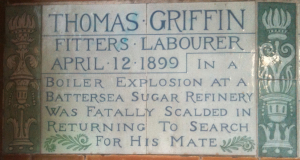
GRIFFIN, Thomas ... died selflessly in an accident at work in a Battersea refinery in 1899. His memorial in Postman's Park, City of London, reads ... "Thomas Griffin - fitters labourer - April 12 1899 - in a boiler explosion at a Battersea sugar refinery was fatally scalded in returning to search for his mate." (from Ben Schott, Daily Telegraph, 4 Oct 2003) [I will visit and photograph this myself soon] ... !! image © bryan mawer 2016. HAINES, George ... got his hand caught in the machinery of the steam engine at a sugarbaker's in Limehouse, and his arm was drawn into the cogs and wheels. At the London Hospital, his arm was amputated at the shoulder, but "the unfortunate man lies in a very precarious state". (Morning Post 1846) HAMPER, Daniel ... German sugar refiner, aged 70, died at London Hospital from injuries received. When stood in a chandler's shop in Fashion St, Spitalfields, the floor gave way and he fell, legs apart, across a rafter resulting in a crushed pelvis. Taken to hospital, but he did not survive the operation. (Hereford Times 1842) HARRISON, James ... 1 Apr 1758 - a mariner aboard a King's Lynn vessel, docked at Sunderland, collapsed whilst he and other members of the crew were engaged in hoisting a hogshead of sugar out of the hold. He was carried below but died some 10 hours later. (King's Lynn Borough Archives, Ref: KL/TS 8) HAWTHORNE, Dugald ... 60 Wellington Street, killed in an accident at D. & J. Gibb's sugarhouse in Sugarhouse Lane, Greenock on 29th January 1878. (Watt Library BMD Index online) HEMMINGS, John ... age 25, killed at Finzel's cooperage, Counterslip, Bristol, when huge stacks of staves toppled over onto many workmen, 1876. (Paul Townsend / Flickr online) HENCKE, Carsten ... a worker at H&S Frieacke of 205 Upper Thames St was beaten about the head with a poker by a fellow worker Dedrich BUTT following a disagreement in the Men's Room of the sugarhouse on the evening of Saturday 28 Dec 1816. He died the following Friday evening from a fractured skull and damage to the brain. The ruling of the inquest was Manslaughter and Butt was taken into custody. (The Morning Chronicle 7 Jan 1817) HENDERSON, David ... age 5, drowned in the burn beside the sugarhouse in Cartsdyke, Greenock, on 31st July 1824. (Watt Library BMD Index online) HENGE, Johann ... a stoker at Hall & Boyd, was given no hope of survival at the London Hospital following severe scalds received in the boiler explosion of Monday 12 Nov 1855. (The Times 16 Nov 1855) HICKS, Francis ... age 36, a worker at Finzel's, Bristol, died in cistern explosion, 1865. He left a wife and 8 children. Verdict - "the material with which the cistern had been made was too thin." (BRO 36772 Box 6) HILL, Hugh ... sugarhouse labourer, 3 West Stewart Street, killed by a runaway horse in Cathcart Square, Greenock on 1st November age 35. (Watt Library BMD Index online) HODGKINSON, William Henry ... "Inquiry into the death of William Henry HODGKINSON aged 17 employed at the sugar refinery of Messers FAIRRIE Vauxhall Rd. Deceased working at a sugar cutting machine and was caught in the belting he was carried round on the driving shaft and killed out-right. It was surmised the belt came off and the deceased tried to replace it while the machinery was in motion ; [verdict] accidental death." (Liverpool Journal - 18th Jan 1908) HOLSTEIN ... a worker at Hall & Boyd, died at the London Hospital from severe scalds following the boiler explosion of Monday 12 Nov 1855. Verdict - accidental death. (The Times 16 Nov 1855) HORMAN, John ... "Struck on head by sack of sugar." Accidental death, 1831, Whitechapel. (Coroner's Inquest. LMA MJ/SP/C/E/4713) HORSE (1) ... a horse belonging to Patten's & Co dropped dead while pulling a car with boxes of sugar in Baker St, Greenock, on 31 March 1868. (Greenock Telegraph & Clyde Shipping Gazette) HORSE (2) ... a horse was killed while being backed into the premises of John Scott & Sons, Baker St, Greenock. The animal fell over a wall onto the boilers. September 1877. (Greenock Herald 22 Sept 1877) IRVING, Edmund ... aged 34, clerk to Mr B Chapman of Brick Lane, Bow, from drinking oil of bitter almonds by mistake. (Morning Post 7 Nov 1843) ISREAL, Johann ... a worker at Hall & Boyd, was dead on arrival at the London Hospital following severe scalds received in the boiler explosion of Monday 12 Nov 1855. Verdict - accidental death. (The Times 16 Nov 1855) IVES, William ... a boy at Cowan & Son, Barnes, died in pan explosion, 3 Jun 1863. (Bell's Life in London & Sporting Chronicle) JOHNS, James ... "The deceased was a sugar baker and worked for Mr Finzel; he was 55 years of age, married with several children. On Saturday night, he was in the third loft of the premises, preparing to leave work, when he accidentally fell through the pulley hole to the bottom of the building, and received such dreadful injuries that he died in a few minutes; he said his back was broken. Verdict: accidental death." (Bristol Mercury, 23 Nov 1844) JONES, Hugh ... in fire at Brancker's, Liverpool ... jumped from 6th floor to adjoining roof, rescued by ladders, severe burns to arms, head and chest, died in hospital some 2 wks later. Inquest verdict: "Died by accidental burning at a fire which took place from some cause unknown." (Liverpool Mercury, 30 Dec 1843; Liverpool Mail, 13 Jan 1844) JONES, William ... "We mentioned in our last publication the awful and melancholy death of a man in consequence of a hogshead of sugar falling from a warehouse upon him and dashing his head to atoms. The name of the unfortunate man was William JONES. He has left a widow and six helpless children (one of them a cripple) who were solely dependant on his daily labour. He was once in a respectable situation in this town as a grocer, and was known to most of the trade. To add to the distress of this bereaved family, the whole of their furniture was sold on Thursday proceeding for rent: and every window and door taken out of the house, and the chimneys built up. Any donation will be recieved at this office; and we trust that an appeal, under such circumstances, will not be made in vain to the well known charitable disposition of the inhabitants of this town." (from Liverpool Mercury, September 1819 ... found on the Lancsgen List - BM) KELLY, William ... cleaner, 11 Mill Street, killed in Glebe Sugarhouse, Greenock on 7th September 1892. (Watt Library BMD Index online) KENNEDY, John ... labourer, 14 Cathcart Street, killed in Berryards Sugar Refinery, Greenock, on 5th May 1894 age 52. (Watt Library BMD Index online) KENNEDY, William ... injured in explosion at Dellingburn Sugar Refinery, died at Greenock Infirmary on 13th July 1873. (Watt Library BMD Index online) KENNY, John ... sugarhouse labourer, Hamilton Street, Greenock, died in Greenock Infirmary on 22nd August 1881 after an accident in the Dellingburn Refinery. (Watt Library BMD Index online) KILLAN, Samuel ... labourer, 3 East William Street, Hillend, died from his injuries received in an accident at Steele and Blair's Sugar Refinery, Greenock, on 9th February 1879. (Watt Library BMD Index online) KORFF, George Willam ... broker of Hackney, in 1831 ... "destroyed himself by cutting his throat whilst taking tea on board a pleasure yacht belonging to his brother, which was moored in the river opposite Greenwich. It was proved in evidence at the coroner's inquest that the deceased had been an inmate of a lunatic asylum at Hoxton, and the jury returned a verdict of lunacy." (London St James Chronicle and General Evening Post, 17 Sep 1831) LAING, Robert ... labourer at sugarhouse of Mr Constadt in Well St at time of huge boiler explosion (see SPEAR, this page). Died, buried in the ruins, 15 Nov 1815. (London Courier & Evening Gazette, 17 Nov 1815) LANGAN, William ... formerly with Roxburgh Street Refinery, Greenock, killed at a sugar refinery at Halifax, Nova Scotia on 5th November 1904. (Watt Library BMD Index online) LEBACK, Frederick ... labourer, aged 55, of 67 Portnall St, Whitechapel, employed at Martineau's Refinery, Christian St, killed in lift accident, 20 Dec 1889. The inquest heard how the deceased was in the basement loading the steam lift with sugar moulds. He called "all" and the lift began to ascend, but then called "hold on" and tried to put a further mould on the lift. It did not stop and he was fatally trapped between the platform and an iron bar. The lift operator was 70ft above on the top floor and did not hear the second instruction ... there was no speaking tube. Fritz Hecker, labourer, witnessed the accident in the basement, however the lift operator Herman Ruthven could not be questioned for lack of an interpreter. Inquest adjourned. (London Standard) LOADER, Robert William ... killed by falling wall at Goodhart's fire, Ratcliff Highway, 28/29 Dec 1840. (Morning Chronicle) LOHDUR, Joshua Dederick ... "The deceased, who was in his 57th year, had a few years since been in affluent circumstances as a sugar refiner, but owing to the great falling off in that, at one time, most flourishing branch of our manufacture, at the east end of town, he became reduced by degrees so as to be compelled latterly to keep a small green-grocer's shop for the support of himself, his wife and his children." The inquest held at the Comet public house in Christian St was told that he swallowed a drachm of prussic acid he had purchased from Mr Allen the chemist of Back Lane. A German by birth, Lohdur was generally respected locally. His disturbed state of mind led to the jury returning a verdict of 'Temporary derangement'. (from The Times, 25 September 1838) LONNON, Frederick Walter ... "Mr Baxter held an inquiry at the Town Hall, Poplar, yesterday morning, into the circumstances attending the death of Frederick Walter Lonnon, aged 15, a labourer, late in employ of Messrs Lyle & Co, sugar refiners, of Silvertown, and living at 41 Mark's Cottages, Barking Road. George Lonnon, father of the deceased, who is in the employ of the same firm, in this evidence deposed that at about four p.m. on Thursday September 26, he was sent for and told that his son had met with an accident. On going to the spot he found him supported by two men and a doctor dressing his wounds with oil and wadding. He was conscious and on witness asking him what had happened he said, "I was washing the staves for the cooper, when one of them slipped. I went to reach it, but missed, and fell head first into the tank of hot water. It was quite an accident and no-one is to blame". The boy succumbed on Thursday to his injuries . The coroner said it appeared to be a case where the factory inspector ought to attend, and as that officer had not been informed, the inquiry was adjourned for him to be communicated with." (The East End News and London Shipping Chronicle 13 Oct 1889 [JJ]) LUFF, Henry ... age 34, killed at Finzel's, Counterslip, Bristol, when changing a belt on the engine shaft - his apron was caught by the revolving shaft and dragged him in. 1852. (Paul Townsend / Flickr online) LUTGEN, Henry William ... "Fell into scum boiler in scum warehouse ..." Accidental death, abt 1828, Whitechapel. (Coroner's Inquest. LMA MJ/SPC/E/3986/unfit) MacMILLAN, Robert ... age 50, sugarhouse labourer, and his son Robert age 12, presumed drowned at the Tail of the Bank, Greenock, on 2nd October 1860. (Watt Library BMD Index online) McCORMICK, Patrick ... St Andrew's Street, died of scalding at Walker's Sugar Refinery, Princes Street, Greenock, on 29th November 1883. (Watt Library BMD Index online) McCORQUODALE, Duncan ... killed in a fall at Scott & Sons, sugar refinery, Drumfrochar Road, Greenock on 21st January 1880 age 70. (Watt Library BMD Index online) McDONALD, Hugh ... labourer, 68 Dempster Street, killed in Roxburgh Street Sugar Refinery, Greenock, on 10th November 1885 age 65. (Watt Library BMD Index online) McEWEN, Mr ... labourer at Hoyle, Martin & Co's sugar refinery, Upper Sugarhouse Lane, Greenock, died there on the 14th May 1862, age 60. (Watt Library BMD Index online) McGILL, Michael ... labourer, died in Greenock Infirmary from injuries received at Blair, Reid and Steele's sugarhouse, Greenock on 1st November 1866 age 66. (Watt Library BMD Index online) McGRATH, John ... "Chest of sugar (13cwt) fell on his head at St Katherine's Dock warehouse." Accidental death, 1831, St Katherine. (Coroner's Inquest. LMA MJ/SP/C/E/4751) McILHENNY, Matthew ... 40 Ann Street, died at Brewer's Sugar works, Greenock, on 9th July 1911. (Watt Library BMD Index online) McINDOE, Thomas ... workman, died in a fall at the sugar refinery of Alex Angus & Co, Greenock, on 26th Jan 1833. (Watt Library BMD Index online) McLACHLAN, Robert ... foreman carter with Neill, Dempster & Neill, Greenock, killed in an accident at the sugar refinery on 17th December 1864 age 40. (Watt Library BMD Index online) McPHAIL, John ... labourer, killed in an accident at Walker's Sugar Refinery, Greenock, on 6th March 1865. (Watt Library BMD Index online) MEEK, John ... 86 Drumfrochar Road, died at Neill, Dempster & Neill sugarhouse, Greenock, on 30th June 1894 age 27. (Watt Library BMD Index online) MILLER, Charles Collins ... 8 Drumfrochar Road, fireman in the Westburn Sugar House, Drumfrochar Road, Greenock. On the 7th May 1941 the sugarhouse was bombed and he died as a result of his injuries at Mearnskirk Hospital. (Ken Redman - family research) MOSS, James ... Duncan Street, Greenock, died at Infirmary after an accident at Walker and Co's sugar refinery on 7th April 1868. (Watt Library BMD Index online) MULLINSTEDT, Frederich ... a worker at Hall & Boyd, was dead on arrival at the London Hospital following severe scalds received in the boiler explosion of Monday 12 Nov 1855. Verdict - accidental death. (The Times 16 Nov 1855) MURDOCH, Donald ... labourer, 25 Bruce Street, died in Walker's sugar refinery, West Shaw Street, Greenock on 10th July 1884. (Watt Library BMD Index online) MYERS, Henry ... aged 23, killed in boiler explosion at Schurrier & Benson, London, 26 Jun 1863. (Lloyd's Weekly Newspaper) NAIRE, James ... "Fell through pulley hole of sugarhouse." Accidental death, 1825, Whitechapel. (Coroner's Inquest. LMA MJ/SP/C/E/2405) NASH, Albert ... age 19, killed at Finzel's cooperage, Counterslip, Bristol, when huge stacks of staves toppled over onto many workmen, 1876. (Paul Townsend / Flickr online) NELSON, William ... labourer, died in Greenock Infirmary on 12th April 1876 from injuries received in an accident at Clyde Sugar Refinery on 9th April 1876. (Watt Library BMD Index online) NEWLAND, David ... "Hogshead of sugar fell on foot." Accidental death, 1827, Whitechapel. (Coroner's Inquest. LMA MJ/SP/C/E/3407) NICOL, Duncan ... cooper, 22, with Hoyle, Martin & Co, Greenock, died in boating accident on Gareloch June 1865. (Paisley Herald and Renfrewshire Advertiser 3 Jun 1865) O'BRIEN, William ... fell from a hydraulic lift at Colonial Sugar Works, Pyrmont, Sydney, Australia, 1882. (Evening News, Sydney, NSW, Tues 24 Oct 1882) PAPEN, Luke ... "... employed at Macfie's sugar warehouse.", Liverpool, died 10 Jan 1859. He committed suicide by cutting his own throat with a razor. Reported in the Liverpool Mercury of 12 Jan 1859. (Ron Hurdus - family research) PATMAN, William ... "Working on top of a sugarhouse, fell" Accitental death, 1832, Whitechapel. (Coroner's Inquest. LMA MJ/SP/C/E/5072) PHELIM, Patrick ... sugarhouse labourer, lived on the smack 'Christian Susan' in Mid Harbour, Greenock, drowned in the harbour on 19th November 1864, age 40. (Watt Library BMD Index online) PIGGOTT, James ... engineman, 72 Ann Street, killed at Berryyards Sugar Refinery, Greenock, on 10th December, age 57. (Watt Library BMD Index online) PLUMB, John ... died following a boiler explosion at John Craven's, 3 Gt Garden St, Whitechapel, on 12 Jan 1861. (The Morning Chronicle) POPLETT, John ... "... aged 35 ... employed at sugar refinery in Church St, Spitalfields ... lying on platform communicating with the lift, when the lift was lowered and he was struck on the head and killed instantly. Had not right being where he was. Verdict - accidental death.", died 14 Aug 1879. (The Times 18 Aug 1879) QUICK, Henry ... age 53, killed at Finzel's cooperage, Counterslip, Bristol, when huge stacks of staves toppled over onto many workmen, 1876. (Paul Townsend / Flickr online) RAAB, Andrew ... aged 46, of 44 Bevington Bush, labourer at Henry Tate & Sons, Love Lane, Liverpool, "... fell from No.3 room into the cellar, and was taken up in an insensible condition and conveyed to the Northern Hospital. He sustained a fracture of the skull, a fracture of the ribs, and other internal injuries. He died the same night ...", leaving a widow and three children. (Manchester Evening News 3 Sep 1875) RAFFERTY, Charles ... engineer, Vennel, died at Greenock Infirmary on 8th July 1872 after an accident at Crawhall, Allison & Co's sugar refinery on 1st July 1872. (Watt Library BMD Index online) RATHGEN, Hans ... age 69, sugarbaker. Cause of death - shock to the system from scalds through having fallen into a pan of boiling sugar. Accidental. Middlesex Coroner's inquest held 18 Sept 1879. (from a death certificate from Ian Rathjen) REGAL, John ... died following a boiler explosion at John Craven's, 3 Gt Garden St, Whitechapel, on 12 Jan 1861. (The Morning Chronicle) REID, James ... sugarhouse worker, 12 Mill Street, Greenock, killed at Ibrox Stadium, Govan on 5th April 1902. (Watt Library BMD Index online) REYNOLDS, Michael ... labourer aged 43 of 18 Shakespeare St, Garston, assisting bricklayer casing some piping very close to the shaft from the engine ... "Frightful Death at Garston" ... "Whilst stooping down his coat became entangled with the shaft and drawn round. The driver stopped the engine as quick as possible, but when the poor fellow was released he was quite dead, both feet being cut off above the ankles, both arms broken, and otherwise bruised." ... at Bostock's Sugar Works, Garston, Liverpool, 20 January 1893. (Garston & Woolton Weekly Reporter, 28 Jan 1893) RYMETT, John ... fell from a rope, descending from scaffolding at Camden's sugarhouse in Old Gravel Lane, Wapping, 16 Aug 1785. (London Lives / LMA (Middlesex Coroners)) SALTER, Richard ... "Hogshead of sugar fell on him." Accidental death, 1832, Whitechapel. (Coroner's Inquest. LMA MJ/SP/C/E/5180) SAUER, Frederick ... "Fell through loop hole of sugarhouse to ground ..." Accidental death, 29 Jan 1821, Whitechapel. (Coroner's Inquest. LMA MJ/SPC/E/1184) SAUNDER, John ... "Fell through pulley hole in sugarhouse." Accidental death, 1827, St John Wapping. (Coroner's Inquest. LMA MJ/SP/C/E/3410) SCHLUTER, Henry ... "Fell from the sixth floor of a sugarhouse through loop hole while handling a basket of sugar." Accidental death, 1834, Whitechapel. (Coroner's Inquest. LMA MJ/SP/C/E/5625) SCHRODER, Carsten ... "Fell through pulley hole to ground ..." Accidental death, 24 Aug 1820, St George's in the East. (Coroner's Inquest. LMA MJ/SPC/E/1053) SCHRODER, George ... while travelling to family in Brighton, "the reins of the leader became entangled, and Mr Schroder, though requested not to do so by the coachman, jumped down from the box-seat to disentangle them. Whether he fell, or was knocked down by the horses was not clearly remarked, but the wheels passed over his body and killed him on the spot." (Bell's Life in London and Sporting Chronicle 7 Oct 1832) SCHROER, John ... "... sugarbaker, 58 yrs old, committed suicide, 24 March 1889, Enfield." His suicide note states that his wife did not want him when he returned from America after 2yrs away seeking work. (Coroner's Inquest. LMA MJ/SPC/LAN/345a-e) SEAGER, John ... sugarbaker, 36, at Mr Coope's in Betts St, was "killed by a lump of sugar". The practice was to line the men down the stairs about 6 feet apart, then they would throw the finished sugar loaves down from one to the other. One towards the top broke in two, one piece of which hit John Seager, who was the lowest man, on the head and knocked him down. He continued working for 2 hours, but then became giddy and was taken to hospital where he died. Accidental death. (Morning Post 1845) SELMER, John ... aged 33, died following a fall down snow-covered stone steps at Beaumont & Co, Gt Alie St, on 11 Feb 1847. Accidental death. (The Era) SHERWOOD, Joseph ... crushed by falling hogshead. 22/23 April 1841. (The Times) SHIELDS, John ... Charles Street, Greenock, drowned in the pond at the sugar refinery at Port Glasgow Road, Greenock on 9th September 1852. (Watt Library BMD Index online) SHIPWAY, John ... steeplejack, killed when building Finzel's new refinery, Counterslip, Bristol. He fell 50ft to the ground when a plank broke. 1847. (Paul Townsend / Flickr online) SHOLT, Joacum Henry ... "a Dutchman by misfortune scalded to death in the Sugarhouse at Manchester." 10 December 1757. (Coroner's Report LRO QSP 1758/9) SIM, George ... mason, died from injuries received in a fall while working at Messrs Angus & Co's sugar house in the west end of Greenock on 11th September 1826. (Watt Library BMD Index online) SIMPSON, William ... labourer at Bell, Duncan & Scott, Baker St, Greenock, residing in Upper Vennel, whilst cleaning machinery his apron became entangled with the shaft and he was jambed between it and the wall. Although extracted, he died later from internal injuries. He left a widow and seven children. May 1863. (Greenock Advertiser 30 May 1863) SLADE, Joseph ... age 35, a worker at Finzel's, Bristol, died in cistern explosion, 1865. He left a wife and 5 children. Verdict - "the material with which the cistern had been made was too thin." (BRO 36772 Box 6) SMITH, Andrew ... died at the sugarhouse of Henry Ehlers on January 22 1745. John
Reese was charged with his murder and his trial took place at the Old Bailey on 27 February
1745 ... SMITH, Charles ... "Chest of Brazil sugar (1500lbs) fell on him." Accidental death, 1831, Whitechapel. (Coroner's Inquest. LMA MJ/SP/C/E/4763) SPEAR ... "... a dreadful explosion took place at the sugar-baking warehouse of Mr Constadt ... the Engineer was testing the new boiler holding about 2000 gallons ... it overheated ... a general explosion took place, carrying in the awful crash utter destruction to the concern, and closing in the ruins more than twenty people ... many were dragged clear with dreadful lacerations and conveyed to the London Hospital ... three bodies were later removed, one being that of the son of Mr Spear, one of the partners in the concern ... the ruins later burst into flames, burning down the adjoining sugarhouse of the same concern ... more people were killed. A Coroner's Inquest sat on Thursday upon three of the persons killed, when the Jury returned the verdict, that the deceased persons came to their death - Accidentally, Casually, and by Misfortune." 1815, Well Street, Wellclose Square. (AGFHS Sugarbakers Guide) STEVENSON, Allan ... 13 Bruce Street, overcome by fumes at Blair Reid & Steele's sugar refinery, Greenock, on 24th September 1875, age 20. (Watt Library BMD Index online) STEWART, Alexander ... killed whilst working at Brewers Quay, Allhallows Barking, by a falling hogshead of sugar, on 5th January 1791. (London Lives / LMA / City of London Coroners: Inquests into Suspicious Deaths) SWINWELL, James ... fireman, Watson's Lane, killed by a falling stack at Scott & Son's sugarhouse, Baker Street, Greenock on 21st February 1884 age 50. (Watt Library BMD Index online) TULLEY, Patrick ... a worker at Cowan & Son, Barnes, died in pan explosion, 3 Jun 1863. (Bell's Life in London & Sporting Chronicle) TYE, James ... aged 30, engineer, scalded to death in boiler accident at Craven & Lucas, Duncan St, Whitechapel, 20 July 1843. Accidental death. (The Era) WALKER, Alexander ... cooper, 7 Octavia Cottages, killed at Walker & Co. Sugar Refinery, Princes Street, Greenock on 17th January 1889 age 61. (Watt Library BMD Index online) WALLACE, Robert ... foreman, 70 Roxburgh Street, killed at Roxburgh Street sugar refinery, Greenock, demolition on 25th Nov 1907 age 35. (Watt Library BMD Index online) WEIR, Patrick ... trace boy, 15/17 Cartsburn Street, killed in an accident at a sugar store, 56 East Hamilton Street, Greenock on 5th March 1883 age 16. (Watt Library BMD Index online) WELSH, William ... sugarhouse labourer with Blair, Reid & Steele, Greenock, presumed drowned at the Tail of the Bank on 2nd Oct 1860. (Watt Library BMD Index online) WILLIAMS, George ... "... foreman to Mr Coslett in Wentworth St, London, fell from the roof of the premises, and his head coming in contact with a copper-boiler, occasioned his immediate death." (Hampshire Chronicle 10 Sep 1804) WILSON, Lachlan ... formerly from Islay, sugar boiler with Paul, Sword and Company, shot himself at his brother in law's, Sword Street, Greenock on 10th May 1873 age 21. (Watt Library BMD Index online) WILSON, William ... kilndrawer, 14 Mill Street, found in Neill, Dempster and Neill's sugar refinery, Greenock, on 22nd November 1893. (Watt Library BMD Index online) WINDELER, Jurgen ... "Cause of death - Exhaustion due to scalds received by falling into sugar that had boiled over at Messrs Fairrie & Co’s refinery, Vauxhall Road on the 20th ultimo but who turned on the steam which caused the sugar to boil over. The evidence is not sufficient to ... " Died 7 July 1898 at 'The Northern Hospital', Liverpool. (Death Certificate. [ES]) WOODS, Robert ... lost in the fire at Brancker's, Liverpool. (Liverpool Mercury 30 Dec 1843) WOOLLEY, John ... age 36, a worker at Finzel's, Bristol, died in cistern explosion, 1865. Verdict - "the material with which the cistern had been made was too thin." (BRO 36772 Box 6)
Mr Boltmire's in Ratcliffe Highway, London ... the sugarhouse collapsed during a fire, and the following day 11 persons were dug out of the ruins, and several were still missing. (Derby Mercury 2 March 1770) Rupert St, London ... "On Christmas night a young German sugar-baker being ill of a fever, at the Crown Public House, in Rupert-street, Goodman's-fields, during the absence of the attendant, threw himself out of a two pair of stairs window, and died." (Bury & Norwich Post 6 Jan 1802) Whitechapel, London ... the son of a butcher was run over by a cart going to a sugarhouse in Goodman's Fields. He was taken to his parents house without hope of recovery. (Morning Chronicle 5 Dec 1804) Thames St, London ... "A scaffold, on which eight men were at work, at a sugar-baker's in Thames-street gave way, when four of them were killed on the spot, and the others taken to hospital in a hopeless state." (Bury & Norwich Post 19 Jun 1805) At Keeling's Sugar Mould Pottery, Tanner's Hill, Deptford ... 2 men, WATTS aged 21 and DARVILL, killed, and 2 men, J. BRIDGELAND aged 70 and James ARNOLD, seriously injured in collapse of the building. 27 Feb 1830. (Bell's Weekly Messenger, 28 Feb 1830) At Ring & Viccars, Vauxhall Rd, Liverpool ... two boilers exploded sending the sugarhouse roof and other debris onto a house in Maguire St. Mr John MINCUR a visitor to the house was killed, along with two men whitewashing a neighbouring cottage. 3 bodies were removed from the ruins of the sugarhouse, John COLLEY and W. YOUNG both enginemen, and labourer Henry BENNETT. (The Times) & (Norfolk Chronicle 23 May 1835) At Craven's, London ... two workmen scalded to death. 21 Jul 1843. (The Times) At Messrs Foeltscher & Co, Suderberg, Prussia ... Boiler explosion. "Fragments of the boiler struck 33 workmen, four of whom were killed on the spot, six died whilst being conveyed to the hospital, and eight died the following day. The remaining fifteen were not out of danger when the account came away." 30 Sep 1847. (Lloyd's Weekly London Newspaper) At Wilson's, Glasgow ... fourteen workmen died in building collapse. 30 Oct 1848. ... James DOGHERTY, John ALFORD or HELFERTY aged 50, Thomas LOVE, Michael KING, Robert BAILLIE overseer, William CARNBRAE, Hugh HARVEY, John KINNEAR, Michael HAGGERTY, John McLEAN, Andrew BRADLEY, Richard GAGE, Charles GALLOCHER, John McGUIRE. (Freeman's Journal and Daily Commercial Advertiser - from Glasgow Courier) At Hall & Boyd's, London ... six workmen, listed above, scalded to death. 12 Nov 1855. (The Times 16 Nov 1855) At Finzel's, Bristol ... four workmen, listed above, killed and 6 others injured in explosion. 1865. (BRO 36772 Box 6) At Leith ... The Leith Sugar refinery, which was being erected in the Bonnington road, fell yesterday afternoon, burying a number of workmen in the ruins, Four men were killed and two injured - one dangerously. Feb 1866. (Dundee Advertiser 18 Feb 1866) At Henry Tate & Sons, Liverpool ... Michael RUSSELL and Thomas McDONOUGH with others were moving a hogshead across a room. The hogshead rolled onto the stage of the hydraulic hoist, which immediately raised it nine feet fatally crushing the two men against the ceiling. Inquest verdict undecided, accident or carelessness. June 1875. (Prescot Reporter & St Helens Gen Advertiser 19 June 1875 / Hull Packet 25 June 1875) At Purity Distilling Company, Boston ... "A large molasses storage tank burst, and a wave of molasses rushed through the streets at an estimated 35 mph (56 km/h), killing 21 and injuring 150." 15 Jan 1919. (Wikipedia) |
******
|
"The Old Sugar House Company [Belfast] offered £52 10s regard to anybody giving information as to who started the rumour that a man fell into a pan of sugar and was boiled to death and that the sugar was afterwards sold."
|
******
|
|
|