|
|
Park family grave at St Michael and All Angels Church, Cockerham |
Most of what I know about William comes from his will, which was written nine days before his death. In his will he mentions his wife Margaret, a brother Thomas Park of Ellel, another brother Henry Park of Inskip, and three children:
William described himself as a yeoman farmer of Thurnham in the parish of Cockerham, Lancashire. The township of Thurnham lies about 5 miles south of Lancaster and was divided between the parishes of Cockerham and Lancaster. That part within Cockerham parish includes the settlements marked on modern maps as Upper Thurnham and Lower Thurnham.
All five members of the family are listed in the 1767 Returns of Papists, residing in Cockerham.William bequeathed to his son James (aged about 12 at the time), his "real and freehold estate" in Forton, upon reaching the age of twenty-one.
William died on 25th December 1771, at the age of 54, and was buried at Cockerham.
His widow Margaret died on 29th December 1795, aged 60, and was also buried at Cockerham.
|
|
Park family grave at St Michael and All Angels Church, Cockerham |
From his age at death, it can be deduced that James was born in or about 1759, probably in the Thurnham / Cockerham area of Lancashire. His father willed him to inherit property in Forton upon reaching the age of 21, but I have not yet found any evidence of him living there. He married Grace Blackburn of Claughton near Garstang, at St Helen's, Churchtown, on 19th April, 1787. They had 6 children, who were probably all born in Thurnham, and were all christened at Thurnham RC church:
The parish register entries for the above christenings all describe James as a farmer, of Thurnham.
A notice in two issues of the Lancaster Gazette in 1803 indicate that he was the owner of the Dalton's Arms inn at Glasson Dock, and was seeking a new tenant.
James died on 28th July 1816, aged 57, and the circumstances of his death were reported in the Lancaster Gazette of 3rd August 1816:
On Saturday afternoon, as Mr. James Park, of Thurnham, was returning home from our market, in his shandray cart, part of the harness gave way; he got out of the cart, and in endeavouring to stop the horse, he was thrown down, and so bruised as to cause his death early the next morning.
He wrote his will on the evening of the accident, with his children Margaret, Elizabeth, Joseph and Grace being the main beneficiaries. He indicated that he had already made gifts to his other two children, in William's case his estate at "the Point", which I have not yet found, but may relate to properties at Glasson Dock (Fishnet Point). When the will was proved, James's estate was valued at up to £1,500.
Possibly more interesting than the contents of his will was the document on which it was written - an arithmetic exercise book which appears to have belonged to his 15-year-old daughter Grace. Some examples contained in it: If I pay £147 18s for 273 yards of cloth, what did it cost per yard? (answer: 10s 10d); In 680 Dollars, each 4s 6d, how many pounds? (answer: £153); If 9 Tuns cost £850 10s, what is that per gallon? (answer: 7s 6d). All the workings are clearly written out. Few girls received any education in those days, but James clearly believed in giving his children the best possible start in life. Grace went on to become head of the Catholic Denominational School in Bathurst, New South Wales.
James was buried at Cockerham on 30th July, in the same grave as his parents.
James's widow Grace died in 1836 at the age of 79, in Walton, near Liverpool, and was buried at Walton-on-the-Hill parish church, although her name is included on the family gravestone at Cockerham. She also left a will, with the value of her "money, property or effects" to be divided among her children, with Isabella to receive five pounds more than the others.
Joseph was born at Thurnham, near Lancaster, and christened at the Roman Catholic church there on 2nd March 1795. He was confirmed into the church, at Thurnham, on 14th September 1813. In his father's will dated 1816, he is described as 'of Park Side' which is a farm in the township of Ashton, between Galgate and Conder Green.
He married Elizabeth Chatburn on 26th October, 1819, at St Mary's parish church, Lancaster. His occupation is shown in the marriage register as "gentleman", an indication of the family's social standing. Joseph and Elizabeth had ten children, all of whom were baptised at Thurnham:
Joseph, like his father, was a farmer. It seems that after his father's death in 1816, he farmed at Thurnham rather than Park Side - he was advertising for a tenant for Park Side in 1820. However, the birthplaces of his children born after 1830 are usually given as Ashton, which may indicate that he returned to Park Side then.
By 1840, Joseph had given up farming, and was a publican at the Green Dragon Inn in Galgate. On 10 April 1841, Joseph was in court accused of opening his public house on a Sunday during Divine Service. His defence was that he was entertaining two visiting nephews who were sailors, and the case was dismissed.
On 25 August 1841, the Green Dragon, associated buildings and two closes of land were put up for sale by auction. It would seem that only the Inn, Stables and two gardens were sold, as the lock-up coach house, barn, shippon, butcher's shop and two closes of land were again being offered for sale by Joseph on 7th November 1843.
In 1844 he was the tenant of a cottage and garden in Galgate, which was for sale by the owner. He was also removed from the list of voters in that year, which suggests that he no longer owned any property.
By 1851 Joseph, his wife Elizabeth and their son Edmund had moved to Liverpool and were living at 15 Ellensborough Street. Joseph's occupation was shown as Warehouseman, which seems to be a big fall from his former standing as a gentleman farmer.
On 7 Feb 1854, the Dalton Arms at Glasson Dock, in the possession of Thomas Lund, was offered for sale "for the life of Mr Joseph Parke of 8 St George's Terrace, Comus Street, Liverpool … and for 21 years afterwards"
Joseph died on 26th September 1854 at George's Terrace, Comus Street. He was buried at Cockerham.
By the time of the 1861 census his widow Elizabeth was at 65 Christian Street, Liverpool, occupation Beer House Keeper. Her son Edmund was living with her, employed as a Hotel Waiter, and there was a servant and a lodger also living there. An 1864 directory of Liverpool shows Edmund Park as the licensee of the "Lancaster Arms" at 65 Christian Street. This street has been redeveloped, and I estimate the pub to have been about where No.11 Christian Street is today.
By 1871 Elizabeth had returned to live in Galgate (No.3 Marginson's Cottages) with a grand-daughter Mary Jane Park (daughter of Joseph). She died at Galgate on 20th June 1873, and was buried at Cockerham.
Robert was born on 16th December 1832, probably at Ashton, south of Lancaster, where his father was a farmer. He was christened on 18th December at the Roman Catholic church at Thurnham. In 1841 he was living with his family in Galgate; in 1851 he was a farm labourer at Fox Holes Farm, Nether Wyresdale. By 1858 he had moved to Liverpool, and was living at 236 Mill Street, occupation Barman.
He married Jane Hallewell at St Thomas's Church, Liverpool, on 14th January 1858. Jane was the daughter of John and Mary Hallewell (also spelt Halliday, Holiway) of Clifton, near Preston. The Hallewells, like the Parks, were Catholics and farmers, so their marriage in an Anglican church in Liverpool is surprising. Robert and Jane had seven children:
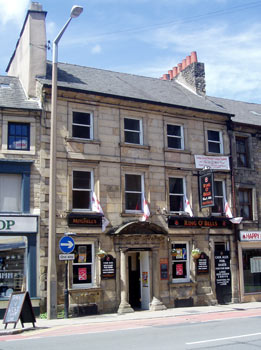
Robert and Jane lived in Heysham after their marriage (their first child was born there), but by 1861 they were residing at Tongue Moor, near Littledale Hall, in a secluded valley a few miles to the east of Lancaster. Robert's occupation at that time was coachman. The birthplaces of their children suggest that the family moved to live in Lancaster by 1863. By 1869, Robert had followed his mother's example and become the beer house keeper at the Ring of Bells public house in King Street, a pub which still exists today.
|
|
The Ring o' Bells |
On 1st April 1869, Robert was charged with neglecting to admit a police constable to the Ring of Bells, when requested. According to the Lancaster Gazette, the Superintendent told the court that "he had heard a good many complaints about card playing being allowed in the house". He was fined 10 shillings, with 10s 6d costs.
Robert died aged 39, on 24th August 1872, of tuberculosis, shortly after the birth of his youngest daughter. According to the death certificate, he had been suffering from tuberculosis for 1½ years - place of death was Galgate, a village south of Lancaster. His widow Jane continued as licensee of the Ring of Bells for a further nineteen years (until 3rd December 1891), as well as raising the large family, one of whom, William, was blind. By 1896 Jane was living in retirement at 28 Thurnham Street, a large house near the centre of Lancaster, which she shared with her daughter Alice's young family, her son William, and some lodgers. Later, they all moved to 71 Dale Street, where Jane died on 15th January 1919, at the age of 83. Jane was buried in Lancaster Cemetery.
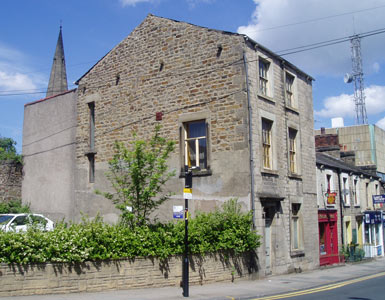
Alice was born at the Ring of Bells beer house (2 King Street), Lancaster, on 6th August 1872. She would have been raised by her widowed mother, who continued to run the beer house following her husband's early death through tuberculosis. Some time between 1891 and 1896, the family moved to 28 Thurnham Street, Lancaster.
|
|
28 Thurnham Street,
Lancaster |
Alice married Henry Pedder, a railway clerk, on 23rd January 1896. The marriage took place at St Thomas's Church, an Anglican church almost directly behind the house in Thurnham Street. This was despite the Catholic background of the Parks, and the non-conformist background of the Pedders. Their children were, however, brought up as Catholics. For some years following their marriage, Henry and Alice lived with Alice's mother at 28 Thurnham Street, Lancaster. In 1901, there were also two lodgers staying at this address.
They had 5 children:
By 1909 the family, including Alice's mother, had moved to a large terraced house at 71 Dale Street, Lancaster. The loss of two of their children, due to illnesses, in the space of less than two years, must have been very distressing.
Alice was partially-sighted, possibly as a result of measles in childhood.
Henry and Alice moved to 9 Chester Place, Lancaster in the early 1940s. Henry died in 1944 at the age of 73, Alice died on 23rd November 1958, at Chester Place. Cause of death was bronchitis. In her will, she left all her possessions to her daughter Mabel. She was buried in Lancaster Cemetery.