What's So Amazing About Grace by Philip Yancey (Zondervan, 1997)
As I look back on my own pilgrimage, marked by wanderings, detours, and dead ends, I see now that what pulled me along was search my for grace ... I have barely tasted of grace myself, have rendered less than I have received, and I am in no wise, an 'expert' on grace. These are, in fact, the very reasons that impel me to write. I want to know more, to understand more, to experience more grace ... Accept then, here at the beginning, that I write as a pilgrim qualified only by my craving for grace. -- Philip Yancey
[Grace] can be dissected as a frog, but the thing dies in the process, and the innards are discouraging to any but the pure scientific mind. -- Philip Yancey
I have just read a thirteen-page treatise on grace in the New Catholic Encyclopedia, which has cured me of any desire to dissect grace and display its innards ... For this reason, I will rely more on stories than syllogisms. -- Philip Yancey
Ungrace causes cracks to fissure between mother and daughter, father and son, brother and sister, between scientists and prisoners, and tribes and races. Left alone, cracks widen, and for the resulting chasms of ungrace there is only one remedy: the frail rope-bridge of forgiveness. -- Philip Yancey
He who cannot forgive another breaks the bridge over which he must pass himself. -- George Herbert
The strongest argument in favour of grace is the alternative, a world of ungrace. The strongest argument for forgiveness is the alternative, a permanent state of unforgiveness. -- Philip Yancey
For many, romantic love is the closest experience of pure grace. -- Philip Yancey
If grace is so amazing, why don't Christians show more of it? -- Philip Yancey
Religious faith – for all its problems, despite its maddening tendency to replicate ungrace – lives on because we sense the numinous beauty of a gift undeserved that comes at unexpected moments from Outside. Refusing to believe that our lives of guilt and shame lead to nothing but annihilation, we hope against hope for another place run by different rules. We grow hungry for love, and in ways so deep as to remain unexpressed we long for our Maker to love us. -- Philip Yancey
	The quality of mercy is not strained.
	It droppeth as the gentle rain from heaven ...
	And earthly power doth then show likest God's
	When mercy seasons justice.
		-- William Shakespeare, Merchant of Venice
What is grace? Philip Yancey does not anywhere attempt to define or analyze grace. He refers to the Roman Catholic Church having destroyed grace with its surgical analysis. Maybe like cutting up a frog to see how it works! We destroy life in our quest for the meaning of life. Instead, like Jesus before him using parables, Yancey illustrates grace by example. One of the best examples is given right at the very end of the book, where Jessye Norman appears at rock concert at Wembley.
Rock groups play all day at a concert to celebrate the new found freedoms in Nelson Mandela's South Africa. An Afro-American is the grand finale, but it is not what the crowd wants. She walks on stage in traditional African dress, an opera diva, but unrecognised by this crowd. With no accompaniment, her powerful voice sings Amazing Grace.
The crowd are restless, it is starting to look ugly, but she begins to sing, very slowly, a lone voice all alone:
	Amazing grace, how sweet the sound
	    That saved a wretch like me!
	I once was lost but now am found –
	   Was blind, but now I see.
The crowd falls silent. By the time she is into the second verse, she has the crowd in her hands, by the time she reaches the third verse, several thousand rock fans are singing along.
What happened that night? Everyone knows the power of what is a hymn, written over two hundred years ago by a slave trader, John Newton, who was later in his life to join William Wilberforce in his fight against slavery (and according to Jessye Norman, may have been based upon an earlier slave song). A hymn that became the anthem of the Civil Rights and anti-Vietnam War movement in the US in the 1960s. Jessye Norman confesses she had no idea what happened that night, what amazing power descended on Wembley that night.
Philip Yancey believes he knows what power descended out of the darkness that night:
Jessye Norman later confessed she had no idea what power descended on Wembley Stadium that night. I think I know. The world thirsts for grace. When grace descends, the world falls silent before it.
Grace was the most important message Jesus brought to the world, a world which until then had been governed by the Law, the Law of Moses. He died on the Cross so that our sins may be forgiven, no matter how unworthy we might be.
Aware of our inbuilt resistance to grace, Jesus talked about it often. He described a world suffused with God's grace: where the sun shines on people good and bad; where birds gather seeds gratis, neither plowing nor harvesting to earn them; where untended wildflowers burst into bloom on the rocky hillsides. Like a visitor from a foreign country who notices what the natives overlook, Jesus saw grace everywhere. Yet he never analyzed or defined grace, and almost never used the word. Instead, he communicated grace through stories we know as parables.
We are all pilgrims embarked upon a very unsteady path through life. I found that very often I have signs, signs that I have learnt to follow.
I was on a train to London and met a lovely girl called called Estie. Even then I knew there was something special. We got off the train at our London terminus, but we still continued on our journey together, and it was with a sad heart I parted from her very enjoyable company. We exchanged contact details, and I was delighted to discover we were both from the same town.
I did not know whether we would ever meet again, and so it was with great pleasure I bumped into her again, one day in the street. And so it was we would bump into each other, and time would stand still as we stood chatting. Then I did not see her for many months, I thought that maybe she had returned to her home in South Africa, but luckily after a long period, we saw each other again. Since I had last seen her, she had bought a house not far from where I lived.
We then made the effort to see each other regularly. We would go out together, I would be invited around to her house for a meal, we'd share a bottle of wine, listen to music, and talk. We became very close friends who enjoyed each others company, who trusted each other. I had never been so happy. The inevitable happened, I did not fall in love, I fell hopelessly head-over-heals in love, I did not know that it was possible to fall so deeply in love.
But it was not what Estie wanted. She thought highly of me, cared for me a great deal, but only as a friend. We both found it very hard, Estie felt trapped and no longer in control. Eventually it destroyed our friendship. Estie wanted a break over Christmas, and very reluctantly I agreed. It was the most lonely and miserable Christmas and New Year I had ever spent, and I eventually fell seriously ill. I arrived back home to find Estie had returned all my Christmas presents to her.
One day I bumped into Estie, she would not speak to me, and ran away screaming. Some weeks later I bumped into her again. She was in sheer terror. The look of terror on her face will haunt me for the rest of my life.
Two friends, destroying each other. What a tragic end to a very close friendship. Why this has happened, I do not even begin to understand, and if I try to talk to Estie or ask her to meet me and talk and try to resolve whatever is wrong, she sees it as pressurising her and gets even more upset. And so we plunge deeper into mutual self-destruction.
Whilst this unfortunate little drama was unfolding and becoming ever more tragic with each passing scene, I walked past my local Parish Church of St Peter's and saw a big poster for the Alpha Course (see Alpha: Questions of Life by Nicky Gumbel). I literally walked in off the streets and enrolled. I was back that evening, and to my surprise, I had not even had time to read the paperwork and had had no time to eat, found I was sitting down to a lovely supper that had been lovingly prepared by members of the church. What I learnt that night, and the following weeks, gave me much to think about. I wanted to discuss it with Estie, but she was not around, I wanted to invite her along too, but she was not speaking to me.
A month into the Alpha Course, we had a Saturday morning session, followed by a simple lunch. It was my birthday, but all I felt was a soul destroying unhappiness. I picked up a copy of What's So Amazing About Grace? by Philip Yancey from the bookstall. I got back home and have never had such a bloody miserable birthday. I had hoped Estie may relent, send me a birthday card, send me a text message, call round, call. Nothing.
I sat and read Philip Yancey's What's So Amazing About Grace?. It helped. I cannot say I was a bundle of joy, but it helped. I read, I skimmed, I skipped, it helped. I had intended to go away and read it hence the skimming and skipping, but it helped. I was still reading and skimming and skipping into the early hours of the morning. A week later, I sat and wrote the beginnings of this web page (actually most of it), and continued into the early hours of the morning. I thought at the time I had written most of it, as it was already very long, too long, but as I was later to find, I had barely written half of it.
A week later I did go away (I could not face a further encounter with Estie), and spent a week, at times sitting under palm trees outside a Catholic church, slowly reading and mulling over what I was reading.
On that Saturday session, the topic was the Holy Spirit entering one, being touched by grace. Before one of the workshops, there was a prayer meeting with Nick, the course coordinator. Nick asked the Holy Spirit to enter each and every one of us. One lovely blonde girl was in tears, I felt a slight warm glow, was too in tears, or at least felt very sad, but that was the loss of Estie, a very close friend.
Two days later I was at a meeting in London with Tony Benn, one of the few politicians left of any integrity (he left Parliament after half a century to go into politics). He kindly autographed his latest book, Free at Last: Diaries 1991-2001, for my niece. He was talking about Iraq, but the talk was wide-ranging. There was not a need to attack Iraq, the weapons inspectors had not completed their work and there were peaceful alternatives that had not been explored, let alone exhausted (see Noam Chomsky's Hegemony or Survival). He touched on South Africa. The Blacks were in a majority, they could have mounted an armed struggle, but they chose not to. The dignity of Nelson Mandela when he left Roben Bay Island, he chose forgiveness as the way forward. The dignity of Mahatma Gandhi, Martin Luther King – two men who chose the dignity of non-violence over violence.
Which brings me full circle. Estie is an Afrikaan from South Africa, raised in the Dutch Reform Church.
What is grace?
Philip Yancey deliberately chooses not to define or attempt to analyse. One has to infer it as we travel with him on what is in many ways a semi-autobiographical journey as well as a pilgrimage. But as I got halfway through on my birthday, I felt this increasingly infuriating and frustrating that in the end I had to look up grace in the Oxford Shorter English Dictionary, which is not of a great deal of use, as for almost any word it gives so many meanings as to mean almost anything, one wants, and so it was with grace. But I finally managed to extract the essence within the context Yancey was trying to convey.
Grace: The free and unmerited favour of God as manifested in the salvation of sinners and the bestowing of blessings. The divine regenerating, inspiriting, and strengthening influence. Mercy, clemency; pardon, forgiveness. Phrase: by the grace of God - through God's favour [tr. L Dei gratia]; efficacious grace - a divine influence which inspires its recipient to effect some good act; fall from grace - lapse from a state of grace into sin; loosely lapse from good behaviour into disgrace.
Maybe we learn more from what grace is not: disgrace. Or what a person does: ingratiate. Or from words with the same common root: grateful, gratis. Or someone who has fallen out of favour (fallen from grace): persona non grata (literally a person without grace).
Or maybe we just follow Yancey on his pilgrimage and don't attempt a cold academic meaning but internalise the meaning with understanding. We know intuitively in our hearts but cannot explain, and in its explanation it lacks grace.
We get little hints of grace – when we admire a view, listen to music, fall in love.
I was touched by grace when I walked along the coast in Cornwall and a stunning view unfolded before my feet. I would sit for hours taking in this breathtaking view. When I listen to music by Hildegard von Bingen, who described herself as 'a feather on the breath of God', whose music and paintings were inspired by visions from God. Or when I listen to the
Eric Levi Era trilogy, introduced to me by my lovely friend Estie, inspired by the Cathars who died in the Inquisition, a Catholic Crusade against heretics in France. When I sat and experienced tranquility and peace of mind under the shade of the trees in a square outside a Catholic church. When I watched a sparrow bathe in a fountain. When I met my lovely friend Estie and experienced happiness that I had never felt before, happiness that I felt I had done nothing to deserve.
But into this world intrudes ungrace. How often has God's creation been despoiled and destroyed by the greed of Man? His people servile and prostrate before Mammon, knowing their place in authoritarian structures known as big business, which are smothering the world with the evil of globalisation.
We learn our place and to know ungrace from a very early age. At school our work is handed back, not with praise, but with our mistakes highlighted in red, the colour of blood.
Like city-dwellers who no longer notice the polluted air, we breathe in the atmosphere of ungrace unawares. As early as preschool and kindergarten we are tested and evaluated before being slotted into 'advanced', 'normal', or 'slow' track ... Test papers come back with errors – not correct answers – highlighted. All this helps prepare us for the real world with it relentless ranking, a grown-up version of the playground game 'king of the hill'.
There is a strong connection between shame and guilt and lack of grace.
Lewis Smedes, professor of psychology at Fuller Theological Seminary, has identified three common sources of crippling shame (see Shame and Grace): secular culture, unaccepting parents, and graceless religion.
Secular culture, or pop culture, fashion fascists, skinny supermodels, and contrary, junk food, and moronic music; parents who never approve or praise but are quick to criticise their failures; and for graceless religion we only have to look at much of the Church today, arbitrary rules but no love and forgiveness for those who fall by the wayside.
Yancey talks of churches with no warmth, ungrace. Mercy unstrained, forgiveness. Forgiveness as an unnatural act (see The Lost Art of Forgiving by Johann Christoph Arnold also Why Forgive by the same author and No Future Without Forgiveness by Desmond Tutu), it is so much easier to seek justice, vengeance, the desire to get even.
But as Yancey illustrates with one family where the cycle of hatred has passed from one generation to the next like an inherited gene, neither being prepared to forgive the preceding generation, and in doing so passing their hate to the next generation.
Yancey compares the Church today with that of Christ before there was a Church. He passed his time with sinners, prostitutes, lowly workman, gentiles. In the Church of today, prostitutes, junkies, AIDS sufferers do not feel welcome. We have bigoted attitudes to homosexuals, who show the same determination as Christians being thrown to the lions, as no matter what the obstacles, the hatred, they still want to kneel before God, and hear what he can bestow, but no-one makes them feel welcome. But then the little glimmers of hope, pastors and priests, who themselves are deeply hostile to homosexuality, nevertheless welcome and administer to homosexuals, and in return feel the hostility of fellow 'Christians' who somewhere along the line have lost grace or maybe never found it.
A generation ago, churches in the Deep South, exhibited the same attitude to Blacks. Yancey himself grew up and worshiped in one such church.
When it is suggested to a prostitute that she seeks help from the Church and she shudders with horror, that she does not wish to be made to feel worse about herself than she already feels, we have to ask where has the Church gone wrong, can we even speak of Christianity if the Church lacks grace? The Church that was founded by Paul as 'the gospel of God's grace'.
 Paolo Veronese found himself in trouble with the Inquisition for a painting of Jesus at a banquet (now hanging in the Academy of Fine Art in Venice, Gallerie dell'Accademia). Jesus is with his disciples, in one corner a man with a bloody nose, Roman solders in another, a few stray dogs roaming around, a few drunks, midgets and blackamoors. Paolo Veronese had to explain his irreverence to the Inquisition, he defended his work by explaining these were the people Jesus dined and associated with. He escaped with his skin by changing the title of his painting to a secular rather than religious title Feast in the House of Levi. As now, the Church had somehow lost its way and somehow lost the message of our Saviour.
Rung by rung, Jesus dismantled the ladder of hierarchy that had marked the approach to God. He invited defectives, sinners, aliens, and Gentiles – the unclean! – to God's banquet table.
Yancey compares the Church of today, with the ministry of Christ, where prostitutes, far from feeling ashamed and unwanted, flocked to be at his side:
The worse a person felt about herself, the more likely she saw Jesus as a refuge. Has the church lost that gift? Evidently the down-and-out, who flocked to Jesus when he lived on earth, no longer feel welcome among his followers. What has happened?
In The Jesus I Never Knew Yancey goes further and speaks of Christ himself being hounded on the street if he were alive today working in the streets with beggars, prostitutes and other low life.
I started writing this review of What's So Amazing About Grace? a week after my birthday, and continued on through to the early hours of the next morning. I awoke after little sleep and turned on the radio and listened to the news followed by the Sunday morning service, which that morning was broadcast from the Chapel of King's College, London. The sermon was by Archbishop Desmond Tutu, who was Visiting Professor in Post-Conflict Societies at King's.
Part of the vision of a previous Dean of King’s, Sydney Evans, was to bring people from South Africa, so they could study at King's and then return to serve their country and church. Archbishop Tutu was a student at King's in the 1960s.
It was an amazing sermon, with a powerful and moving message, it reiterated what I had been reading in What's So Amazing About Grace?.
On the day of the resurrection, Mary Magdalene finds the tomb of Christ empty, and siting in his place two angels. She speaks to a man, who she mistakes for the gardener, not recognising it is Jesus. He asks does she not recognise Him, and asks to seek out His friends, His brothers, who share the same Father.
It is difficult for us to appreciate the significance of these associations. We only see Jesus associating with riffraff, slumming it a little.
Palestine of 2,000 years ago was under Roman occupation. It was one of their most troublesome provinces, there had already been several insurrections, and tensions were running high. Palestine of Christ was a highly stratified society: women and Samaritans were despised if not hated, Gentiles could not pass beyond the Temple partition except on the pain of death. Jesus chose as His friends, tax collectors for the Roman occupiers, women, Samaritans, Gentiles. He called them His brothers.
A parallel situations today would be Jews and Palestinians in Jewish occupied Palestine, or racial tension between Blacks and Whites in Apartheid South Africa.
A decade into the end of Apartheid and the release of Nelson Mandela, we tend to forget that during the dark days of Apartheid, with Mandela rotting in prison, Desmond Tutu was a beacon of light shining out in the darkness.
In his sermon Desmond Tutu said Jesus welcomed all: Protestants and Catholics, Jews and Palestinians, homosexuals and so-called straights, Ariel Sharon and Yasir Arafat, Osama bin Laden and Saddam Hussein, even Tony Blair and George W Bush.
The morning Desmond Tutu gave his powerful and moving sermon, was Estie's birthday. If former enemies across the racial divide of Apartheid South Africa can reach reconciliation, cannot two former close friends?
Later, during the evening of Estie's birthday, I listened to highlight's of the previous week's broadcasts. One of these was taken from Monday morning and featured Tony Benn, who I had met up in London that evening. Unfortunately I missed the original broadcast. He was talking about Christianity. With him on the programme was Desmond Tutu.
Forgiveness is an unnatural act, it is far easier to seek vengeance or at the very least seek justice. But where is it to end? An eye for an eye, a tooth for a tooth. Are the Jews to seek the death of 6 million Germans before the slate can be seen as wiped clean? An endless cycle that repeats itself through the centuries and down through generations.
Lewis Smede:
Vengeance is a passion to get even. It is a hot desire to give back as much pain as someone gave you ... The problem with revenge is that it never gets what it wants; it never evens the score. Fairness never comes. The chain reaction set off by every act of vengeance always takes its unhindered course. It ties both the injured and the injurer to an escalator of pain. Both are stuck on the escalator as long as parity is demanded, and the escalator never stops, never lets anyone off.
The sl
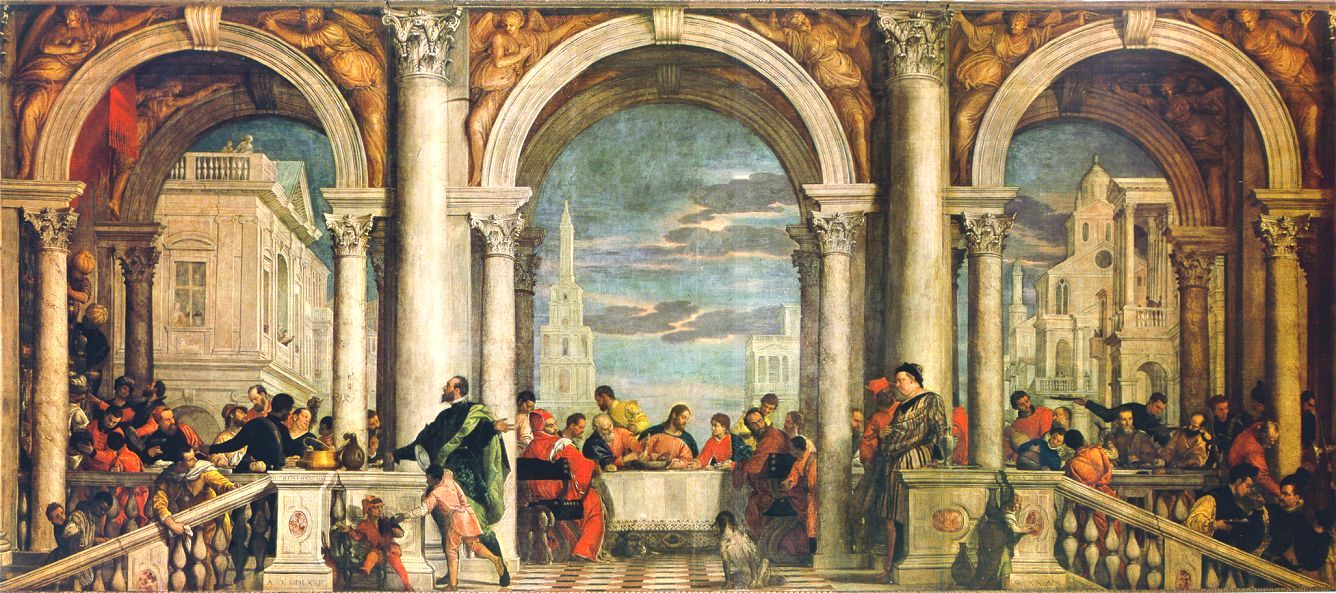 Paolo Veronese found himself in trouble with the Inquisition for a painting of Jesus at a banquet (now hanging in the Academy of Fine Art in Venice, Gallerie dell'Accademia). Jesus is with his disciples, in one corner a man with a bloody nose, Roman solders in another, a few stray dogs roaming around, a few drunks, midgets and blackamoors. Paolo Veronese had to explain his irreverence to the Inquisition, he defended his work by explaining these were the people Jesus dined and associated with. He escaped with his skin by changing the title of his painting to a secular rather than religious title Feast in the House of Levi. As now, the Church had somehow lost its way and somehow lost the message of our Saviour.